
The Reformers identified two marks of a true church: the Word faithfully preached and the sacraments rightly administered. Acts 2:42 describes the Jerusalem community with four, adding fellowship and prayer. Reformed traditions often add discipline as a third, reasoning that a church unwilling to distinguish faithful profession from unrepentant sin has stopped being able to say what it is.
You have probably sat in a service that had all the features: a building, a crowd, music, someone speaking. Something still felt absent. Not the people, not the effort. Something harder to name. The Reformers in the sixteenth century were asking a similar question with much higher stakes. Which communities actually were the church, and which were using the name for something else? Their answer was not primarily about size, tradition, or institutional pedigree. It was about what was happening in the room.
What the Reformers insisted on
Luther and Calvin identified two marks of a true church: the faithful preaching of the Word and the right administration of the sacraments (or ordinances, in Baptist usage). These notae ecclesiae, marks of the church, were not invented to exclude everyone who disagreed with them. They were an attempt to answer a practical question. Where is Christ present and active in a visible way?
The first mark, the Word, comes with Paul's charge in 2 Timothy 4:2: "preach the word; be ready in season and out of season; reprove, rebuke, and exhort, with complete patience and teaching." A church that proclaims the gospel of Christ and calls people to faith and repentance is doing the primary work of a church. One that fills the hour with entertainment, advice, or political commentary without this has something other than a church gathering, however large the crowd.
What Jerusalem looked like
Acts 2:42 describes the earliest community: "And they devoted themselves to the apostles' teaching and the fellowship, to the breaking of bread and the prayers." Four marks, not two. The apostles' teaching corresponds to Word ministry. The breaking of bread corresponds to the Lord's Supper. Fellowship and prayer fill out the communal and devotional life that flows from the first two. The Reformers were not inventing categories. They were distilling what the apostolic community already embodied.
Paul's instruction in 1 Corinthians 11:23-26 treats the Lord's Supper as a proclamation: "you proclaim the Lord's death until he comes." The meal is not only a memorial exercise. It is a corporate declaration of the gospel. Together, Word and table give a congregation two forms of the same announcement.
A third mark some traditions add
Reformed and some evangelical traditions add church discipline as a third mark. The reasoning is simple. A community that will not distinguish between faithful profession and persistent unrepentant sin has, in practice, made the gospel optional. Matthew 18:15-17 gives the procedure: speak to the person, then bring others, then involve the congregation. Paul assumes something similar in Colossians 1:28: "warning everyone and teaching everyone with all wisdom, that we may present everyone mature in Christ." Warning implies the possibility of real confrontation.
The goal of discipline, properly practiced, is not exclusion but restoration. A church that never warns is not being kind. It is being negligent. One that warns constantly without seeking reconciliation has confused discipline with punishment. The mark is the existence of a functioning process, not the frequency of its use.
Why this is pastoral, not gatekeeping
Asking whether a church bears these marks is not a judgment rendered from outside. It is a question a congregation can ask about itself. Is the gospel being clearly announced here? Are the ordinances pointing people to Christ? Is there a community of real accountability and care? If the answer to all three is yes, you have something the Reformers would recognize, whatever the style, size, or denominational label.
The marks are also a useful mirror for cell leaders and small-group shepherds. The mark of the Word applies at scale. It also applies in a living room on a Tuesday night. Is Christ being clearly announced? Is the text being handled honestly? Is there genuine accountability and care? Those questions belong to every gathering, not only to Sunday morning.
This week, read Acts 2:42 with your group and ask which of the four elements the early church devoted itself to your group does most naturally, and which one needs more attention.
Terms in this article
Every passage each one appears in, with the definition attributed to its source.
Keep reading

Leading and Teaching
What the Church Is
Body, bride, household, temple. Four New Testament images for the church, and what each says that "I can worship anywhere" cannot.
Reading the Bible
Gospel Equilibrium
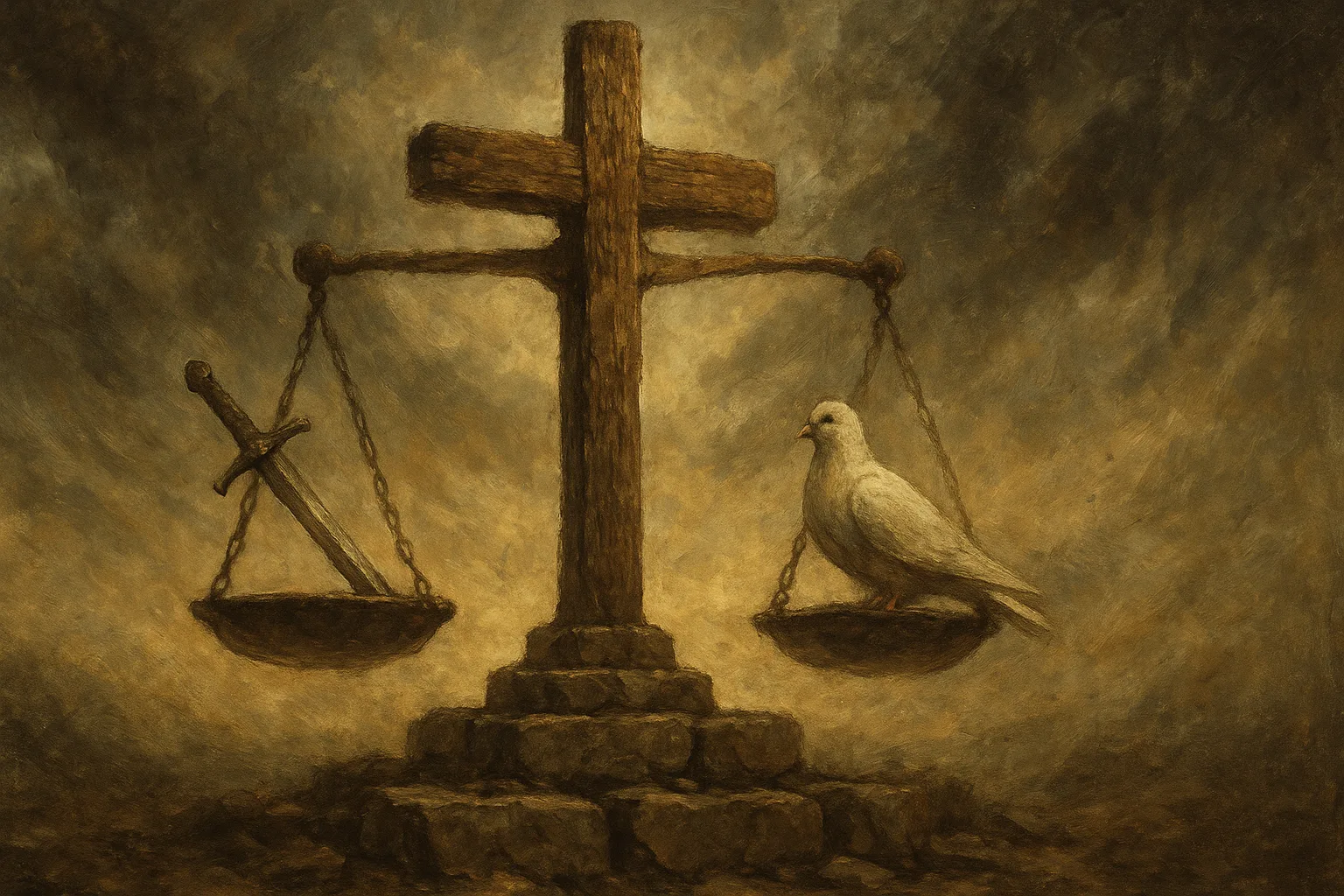
Lose the cross at the center and the gospel tilts: moralism on one side, sentimentality on the other. Why the balance has to be relearned.

Salvation
Repentance and Faith
Peter and Judas both wept. Only one repented. What separates godly grief from remorse, and why repentance and faith cannot be pulled apart.


