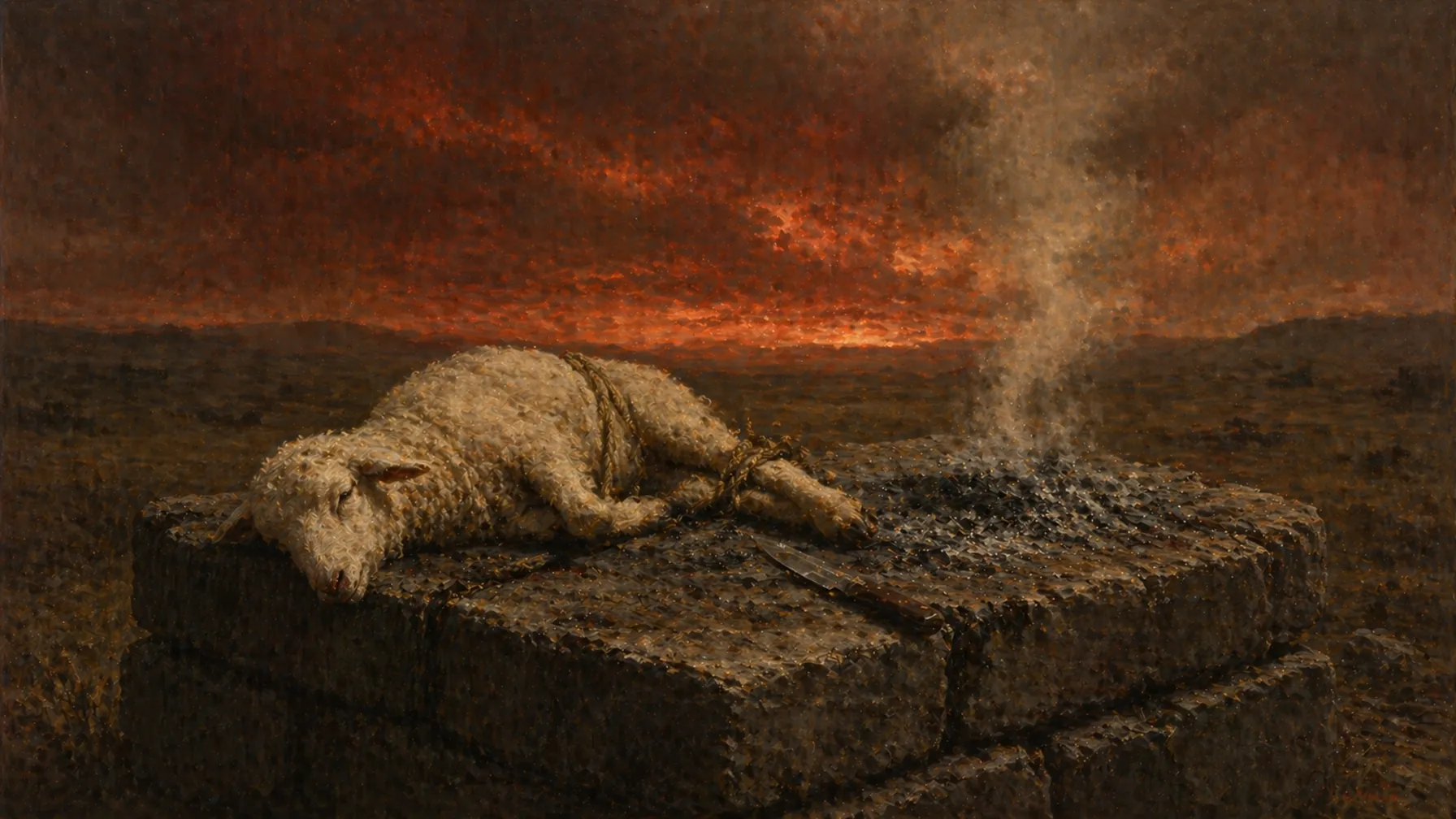
Penal means bearing a penalty; substitution means bearing it in another's place. Both halves are stated in Scripture and neither can be removed without losing something the text says. Romans 3:25-26 is the compressed form, and its word propitiation should not be softened, since Paul's stated reason is to show God righteous in justifying.
In Gethsemane, Jesus asked if the cup could pass from him. He was not asking whether the crucifixion would be painful. He already knew that. He was asking about the cup, a word the prophets used for one thing: the wrath of God poured out on sin (Isaiah 51:17, Jeremiah 25:15). Whatever Jesus was bracing for in that garden was not only nails and a crowd. He was facing the full judicial weight of human sin placed on a single point. That is the doctrine of penal substitution. Not an abstraction. A garden, a prayer, a cup he chose not to put down.
Two elements, both necessary
The word "penal" means bearing a penalty. The word "substitution" means bearing it in the place of another. Both halves are in Scripture, and neither can be removed without losing something the text actually says.
Isaiah 53 holds them together with unusual precision. "He was pierced for our transgressions; he was crushed for our iniquities; upon him was the chastisement that brought us peace, and with his wounds we are healed" (Isaiah 53:5). The preposition matters. Not pierced alongside our transgressions, not sympathetic with them, but pierced for them. Verse 6 completes the picture: "the Lord has laid on him the iniquity of us all." A specific act of transfer. What belonged to many was placed onto one.
Written before Calvin and Luther
Critics sometimes argue penal substitution is a Reformation novelty, a legal metaphor imposed on a text that does not require it. The logic runs through the entire canon, centuries before any Reformer picked up a quill.
Leviticus 16 describes the Day of Atonement. Two goats were brought before the Lord. One was slaughtered. The other, the scapegoat, had the sins of Israel confessed over it and was then driven into the wilderness "to carry all their iniquities on itself to a remote area" (Leviticus 16:22). The transfer is not metaphorical. It is the whole point of the ritual. Sin goes somewhere. It is carried by a substitute and removed from the community.
Jesus himself used substitution language with no prompting from any theologian. In Mark 10:45 he defines his mission as giving "his life as a ransom for many." The Greek preposition anti carries the sense of in place of. Not a ransom alongside many but a ransom that replaces what they owed.
Propitiation: the word that must not be softened
Romans 3:25-26 is the most compressed statement of the doctrine in the New Testament. God "put forward" Christ as a propitiation through his blood, to be received by faith. Paul gives two reasons: to show God's righteousness because he had passed over former sins in his forbearance, and to show his righteousness at the present time, so that "he might be just and the justifier of the one who has faith in Jesus."
The word translated "propitiation" (hilasterion in Greek) is the same word the Septuagint uses for the mercy seat in Leviticus 16, the lid of the ark where the blood of atonement was applied. Paul is not inventing a new concept. He is saying that what happened in shadow form every year on the Day of Atonement happened in full, public, unrepeatable reality when Christ was crucified. The wrath of God against human sin was not ignored, and it was not redirected onto people who deserved it. It was absorbed by the one who did not deserve it, on behalf of those who did.
The great transfer
Three texts in the New Testament describe the substitution from different angles, and each one is specific about the exchange.
Paul writes in 2 Corinthians 5:21: "For our sake he made him to be sin who knew no sin, so that in him we might become the righteousness of God." Not sinful. Not sympathetic to sin. Made to be sin itself. The one without it took it on. Those with nothing but it received what he had. That is double imputation. Our record transferred to him, his record credited to us.
Galatians 3:13 is just as direct: "Christ redeemed us from the curse of the law by becoming a curse for us, for it is written, 'Cursed is everyone who is hanged on a tree.'" Paul does not say Christ illustrated what a curse looks like or stood near the curse as a sympathetic observer. He became it. Deuteronomy 21:23 said anyone hung on a tree was under God's curse. Paul sees the cross as the deliberate, willing entry of the sinless Son into exactly that verdict.
Peter brings it home with physical, bodily language: "He himself bore our sins in his body on the tree, that we might die to sin and live to righteousness. By his wounds you have been healed" (1 Peter 2:24). Not in his spirit only, not in a general representative sense, but in his body. The same body that walked Galilee. The same body the nails went through.
What a guilty conscience actually needs
Some accounts of the atonement describe the cross as a demonstration of love meant to melt our resistance and draw us back. That dimension is real. A demonstration of love, by itself, does not answer the question a guilty conscience is actually asking. The conscience is not asking "Does God care about me?" It is asking "What happens to what I have done?"
Romans 3:26 says God acted at the cross to demonstrate that he is righteous even while justifying sinners. Both at once. A justification built on sentiment alone would leave God's justice unaccounted for. Penal substitution is the answer to how both can be true at once. The penalty was real. The substitute was willing. The transfer was complete. The verdict is not pending.
Ask your group to sit with 2 Corinthians 5:21 for five minutes before discussing it: what does it mean personally that the one who knew no sin was made to be sin, and what does it mean that we might become the righteousness of God in him?
Terms in this article
Every passage each one appears in, with the definition attributed to its source.
Keep reading

Salvation
What Sin Actually Is
Sin is not mainly a list of bad behaviors. What Psalm 51, Jeremiah 2 and Romans 1 each add, and why the diagnosis decides the remedy.

Salvation
Sanctification, The Long Walk
Why forty years in can still feel like slow progress. The two errors that cut the walk short, and why mortification is active rather than passive.

Salvation
Repentance and Faith
Peter and Judas both wept. Only one repented. What separates godly grief from remorse, and why repentance and faith cannot be pulled apart.


