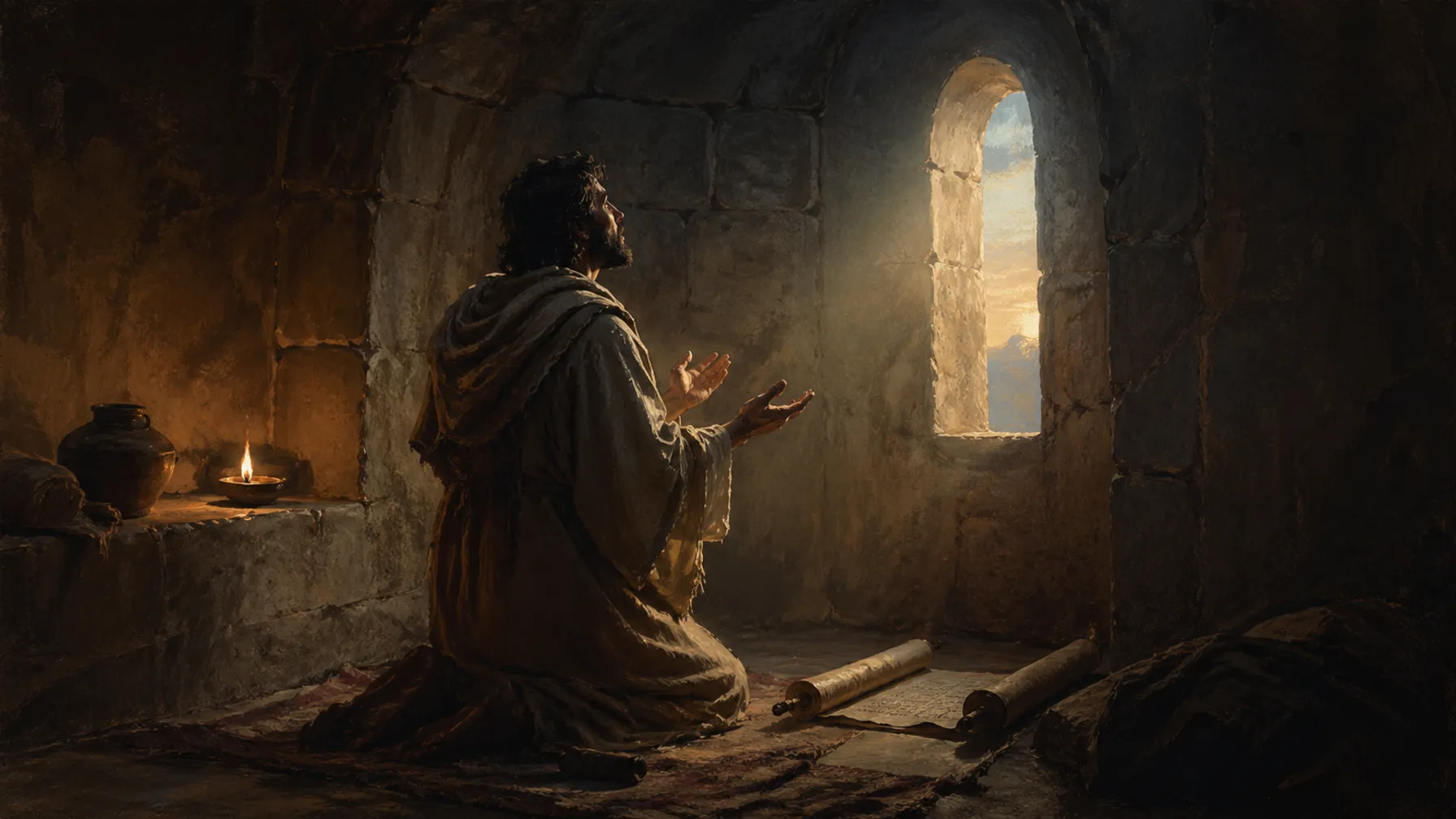
The Lord's Prayer is ordered deliberately. It opens on address, "Our Father," which sets the footing for everything after it. Adoration comes before petition, and alignment with God's kingdom comes before the three requests about human need. Provision is asked daily rather than stockpiled. Psalm 13 shows that asking how long is itself faithful prayer.
A woman in a church small group once confided that she had stopped praying. Not because she doubted God existed. She doubted he was listening in any meaningful way to her specifically. She had been taught to pray with enough faith, to claim promises, to expect results. When the results did not come, she concluded the problem was with her technique. She adjusted. She prayed more. She prayed differently. Nothing shifted. Eventually she stopped. What nobody had told her was that her problem was not technique. It was theology. She had been given a picture of God that made prayer a transaction, and transactions that fail get abandoned.
Address: the God we approach
Jesus opens the Lord's Prayer with two words that carry the weight of the whole structure: "Our Father" (Matthew 6:9, ESV). That is not a warm-up phrase. It sets the doctrinal foundation for everything that follows. The God being addressed is not a distant sovereign who tolerates petitions from his subjects. He is a Father. More precisely, he is the Father of the Son, and through the Son's work, the Father of those who belong to him. Paul puts it directly in Romans 8:15: "you have received the Spirit of adoption as sons, by whom we cry, 'Abba! Father!'" You can only cry that because the relationship behind it is actual. Prayer begins not with our need but with who God is to us in Christ.
The word "Our" is equally important. It is not "My Father." The prayer is corporate before it is private. We pray into a community of adoption, not as isolated petitioners. Isolation in prayer is already corrected before the first request is made.
Adoration before petition
From address, Jesus moves straight into adoration: "hallowed be your name" (Matthew 6:9). Before any human need gets named, the character of God is acknowledged. His name is treated as holy. God-centered before self-centered. That ordering is not incidental; it shapes everything that follows.
David shows what this looks like in real life. Writing from the wilderness, thirsty and worn out, he still opens Psalm 63:1-3 with God: "O God, you are my God; earnestly I seek you; my soul thirsts for you." The need is real, but the orientation is Godward first. Adoration is not a polite formality tacked onto the front of prayer. It is the reorientation that keeps the rest of the prayer honest instead of self-serving.
Alignment before request
"Your kingdom come, your will be done, on earth as it is in heaven" (Matthew 6:10). This is the hinge of the prayer. Two petitions about God's agenda come before the three petitions about human need, and Jesus is teaching that prayer is not mainly about getting God to align with our purposes. It is about aligning ourselves with his.
The practical consequence is significant. A person who prays "your will be done" and means it cannot simultaneously use prayer as a mechanism to extract predetermined outcomes from God. They are releasing their grip on the result before the request is even spoken. This is exactly what Jesus modeled in Gethsemane: "not my will, but yours, be done" (Luke 22:42). The prayer of alignment is not passive resignation. It is the most active kind of trust there is.
Provision and confession
"Give us this day our daily bread" (Matthew 6:11). The petition is deliberately minimal. Daily. Not stockpiled, not secured permanently. The phrase points back to the manna in the wilderness, where Israel received exactly what they needed for one day at a time (Exodus 16:4). The structure of the request cultivates dependence. God is not being asked to fund an independent life. He is being acknowledged as the sustainer of a dependent one.
Immediately after provision comes confession: "forgive us our debts, as we also have forgiven our debtors" (Matthew 6:12). Prayer that skips honest reckoning with sin has not drawn near to God. Isaiah states it plainly: "your iniquities have made a separation between you and your God, and your sins have hidden his face from you so that he does not hear" (Isaiah 59:2). Confession is not morbid self-examination; it clears the way.
Protection and the Spirit's intercession
The prayer closes with a request for protection: "deliver us from evil" (Matthew 6:13). We pray this because we cannot deliver ourselves. The spiritual dimension of human life includes genuine opposition, and Jesus teaches his disciples to name that plainly before God rather than pretend otherwise.
Romans 8:26-27 adds a dimension to the whole picture. There are moments when we do not know what to pray. Paul does not treat this as a failure of faith. He treats it as a condition the Spirit is equipped for: "the Spirit himself intercedes for us with groanings too deep for words. And he who searches hearts knows what is the mind of the Spirit, because the Spirit intercedes for the saints according to the will of God." If prayer were mainly a human performance, wordlessness would be a problem. Because prayer is Spirit-sustained, wordlessness is still prayer. Ephesians 6:18 tells believers to pray "at all times in the Spirit." The Spirit is not an add-on to prayer. He is the medium of it.
When God feels absent
Psalm 13 opens with four consecutive questions: "How long, O Lord? Will you forget me forever? How long will you hide your face from me? How long must I take counsel in my soul and have sorrow in my heart all the day?" (Psalm 13:1-2). This is not a failure of faith. It is a form of prayer the Psalter treats as entirely legitimate. Psalm 88 ends with no resolution at all: "darkness is my closest friend" (Psalm 88:18). The psalmist does not wrap the lament in a tidy conclusion.
Lament is not what happens when prayer breaks down. It is what prayer looks like when the person praying is being honest. The woman who stopped praying had no category for the distance she was feeling. The Psalter would have given her one. Lament addresses God directly in the pain, and that address is itself an act of faith. You do not cry out to someone you believe has abandoned you for good.
What theology does to prayer
A wrong view of God produces wrong prayer. If God is primarily a celestial vending machine, prayer becomes a transaction and silence becomes malfunction. If God is a distant lawgiver, prayer becomes a legal appeal rather than a conversation between Father and child. If God exists to validate personal comfort, lament becomes impossible because suffering would signal divine disapproval.
The Lord's Prayer corrects each of these in sequence. It opens with adoption and closes with dependence. It places God's name and kingdom before personal need. It calls for confession because it is addressed to a holy God who is also a forgiving one. Theology does not make prayer more complicated. It makes prayer more real, because the God being addressed is the actual God instead of a projection.
Ask your group to take one phrase from Matthew 6:9-13 and spend two minutes this week praying only that phrase, slowly, letting the theology behind the words do its work before adding anything else.
Terms in this article
Every passage each one appears in, with the definition attributed to its source.
Keep reading

Christian Life
Dealing With Doubt
Doubt is not one problem but three. How Thomas, John the Baptist, and the disciples at the tomb each doubted differently, and how to respond.
Leading and Teaching
What the Church Is
Body, bride, household, temple. Four New Testament images for the church, and what each says that "I can worship anywhere" cannot.

Doctrine of God
The Work of Christ
Prophet, priest and king are not three phases of Jesus's life. All three offices are active now, which is what the ascension actually means.


