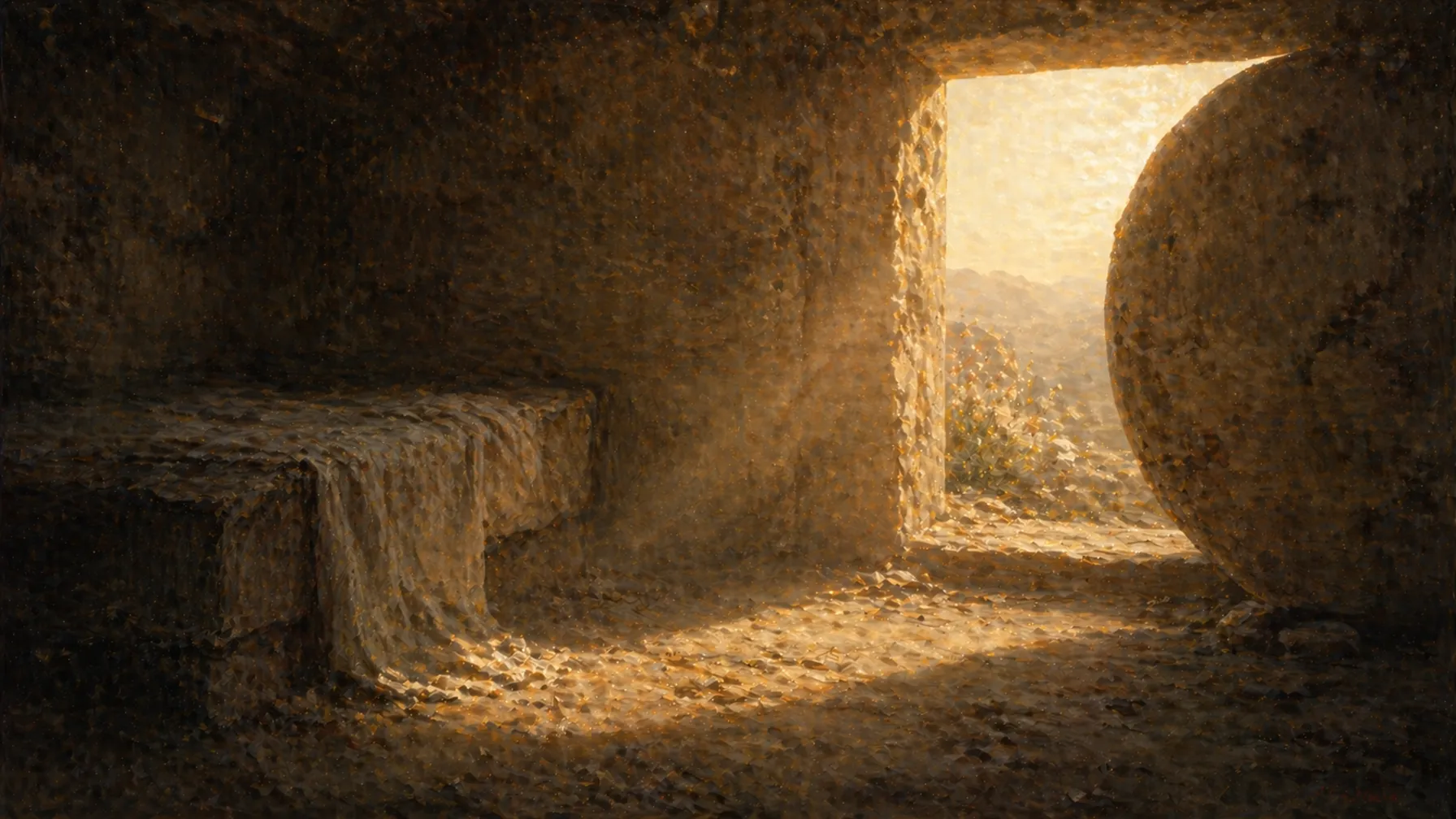
Paul treats bodily resurrection as non-negotiable: without it, he tells Corinth, the preaching and the faith are empty. The insistence on flesh and bones cut against a Greek audience that found bodily resurrection repugnant. Romans 1:4 makes it the event that declares who Jesus is, and 1 Corinthians 15 calls him the firstfruits, the pattern for everyone who follows.
It is Sunday evening. The doors are locked. Ten of the eleven remaining disciples are crowded into a room in Jerusalem, and they are afraid. Three days ago they watched their teacher die. That morning, reports began coming in. The tomb was empty. Mary had seen him. Two others had walked with him on the road to Emmaus. None of it made sense. Then, without anyone opening a door, Jesus stood among them. His first words were not a rebuke for their absence at the cross. They were "Peace be with you" (Luke 24:36).
They thought they were seeing a ghost. Jesus did something unexpected. He showed them his hands and his feet. He invited them to touch him. He asked for something to eat, and they gave him a piece of broiled fish, and he ate it in front of them (Luke 24:39-43). This is not the behavior of a vision. Ghosts do not eat fish.
Paul's non-negotiable
Two decades after that evening, the apostle Paul was writing to a church in Corinth where some members were suggesting that bodily resurrection was not really part of the Christian message. His response is the most concentrated argument in the New Testament on the subject. He begins by reminding them of what he had delivered to them "as of first importance": that Christ died for sins, was buried, was raised on the third day, and appeared to Peter, then to the Twelve, then to more than five hundred brothers at one time, then to James, then to all the apostles, and last of all to Paul himself (1 Corinthians 15:3-8).
Notice the structure. Paul names witnesses. He cites appearances. He gives numbers. This is not the language of metaphor or spiritual experience. It is the language of testimony, and it was written within twenty-five years of the events, when many of those five hundred witnesses were still alive and could be questioned.
Then Paul draws the line that has no give in it: "If Christ has not been raised, your faith is futile and you are still in your sins" (1 Corinthians 15:17). He does not say the resurrection would be a meaningful bonus. He says that without it, the entire structure of Christian faith collapses. There is no forgiveness, no living hope, no point. Paul staked everything on a historical claim.
Flesh and bones
The Corinthians were not unique in their skepticism. A Greek audience in the first century found bodily resurrection philosophically repugnant. The body was the problem, they thought. Salvation meant escaping it. The claim that Jesus rose in a body was not only surprising. It was offensive to the categories they already held.
Luke records Jesus addressing this directly. "See my hands and my feet, that it is I myself. Touch me, and see. For a spirit does not have flesh and bones as you see that I have" (Luke 24:39). The phrase is precise. Flesh and bones, not a spiritual impression, not a symbolic appearance. The resurrection did not bypass the body. It transformed it.
Eight days after that first appearance, Thomas was finally present when Jesus came again. Thomas had said he would not believe unless he put his finger into the nail marks and his hand into Jesus's side (John 20:25). Jesus offered exactly that. "Put your finger here, and see my hands; and put out your hand, and place it in my side. Do not disbelieve, but believe" (John 20:27). The wounds were still there. The body that was raised was the same body that had died. Continuity was the point.
The verdict on Christ's identity
The resurrection is not a miracle tacked onto the end of Jesus's life. It is the event that interprets everything that came before it. Paul writes that Jesus "was declared to be the Son of God in power according to the Spirit of holiness by his resurrection from the dead" (Romans 1:4). The resurrection was a declaration, a verdict. Everything Jesus had claimed about himself during his ministry was either confirmed or disproved on that Sunday morning.
Peter made the same connection in his Pentecost sermon. He told a crowd in Jerusalem that David had written of one who would not be abandoned to Hades, and then he said plainly: "This Jesus God raised up, and of that we all are witnesses" (Acts 2:32). God raising Jesus was the divine reversal of the human verdict at Calvary. The same people who had called for his execution were now being told that death itself could not hold him, "because it was not possible for him to be held by it" (Acts 2:24).
Firstfruits
Paul reaches for an agricultural image to explain what the resurrection means for everyone else. "But in fact Christ has been raised from the dead, the firstfruits of those who have fallen asleep" (1 Corinthians 15:20). Firstfruits, in the Old Testament calendar, were the first sheaves of the harvest brought to the temple. They were not the whole harvest. They were the guarantee of it. What you held in your hand on that first day was the pledge that the rest was coming.
Christ risen is not an isolated event. He is the beginning of a harvest. Paul makes the same connection in Romans, where he writes that the Spirit who raised Jesus from the dead will also give life to the mortal bodies of those in whom the Spirit dwells (Romans 8:11). The bodily resurrection of believers is not a separate hope attached to Christianity as an extra. It runs on the same power that operated on the third day.
What changes
A Christianity without a bodily resurrection is a different religion. It might retain the ethical teaching. It might keep the community. It loses its central claim: that the God who created matter redeemed it, that death was not the last word, that the tomb outside Jerusalem was genuinely empty that morning.
The disciples in that locked room did not invent a movement built on a spiritual feeling. They were confronted by a person who showed them his hands and asked for fish. Thomas, the slowest to believe, produced the highest confession: "My Lord and my God!" (John 20:28). That confession was not drawn out by grief or wishful thinking. It was drawn out by evidence he had demanded and received.
Christian faith does not ask for credulity. It asks for a serious reckoning with what Paul and Luke and John and Peter actually claimed, and with whether a movement built on a known fabrication would have survived the first generation in the city where the tomb stood empty and available to anyone who wanted to check.
Ask your group to sit with 1 Corinthians 15:17 and work backward: if Paul is right that everything hangs on the resurrection, what in your life would you need to reconsider if you took that more seriously?
Terms in this article
Every passage each one appears in, with the definition attributed to its source.
Keep reading

Last Things
New Heavens, New Earth
The Bible does not promise an escape from the earth. Isaiah 65, Romans 8 and Revelation 21 describe settlement, and it changes what work is worth.

Last Things
Resurrection and Judgment
Everyone rises, not only believers. What kind of body Scripture describes, what the books at the throne show, and three readings of hell.
Reading the Bible
Reading the Gospels
The Gospels are portraits, not transcripts. Why the church kept four accounts, how to read synoptic parallels, and where John works differently.


