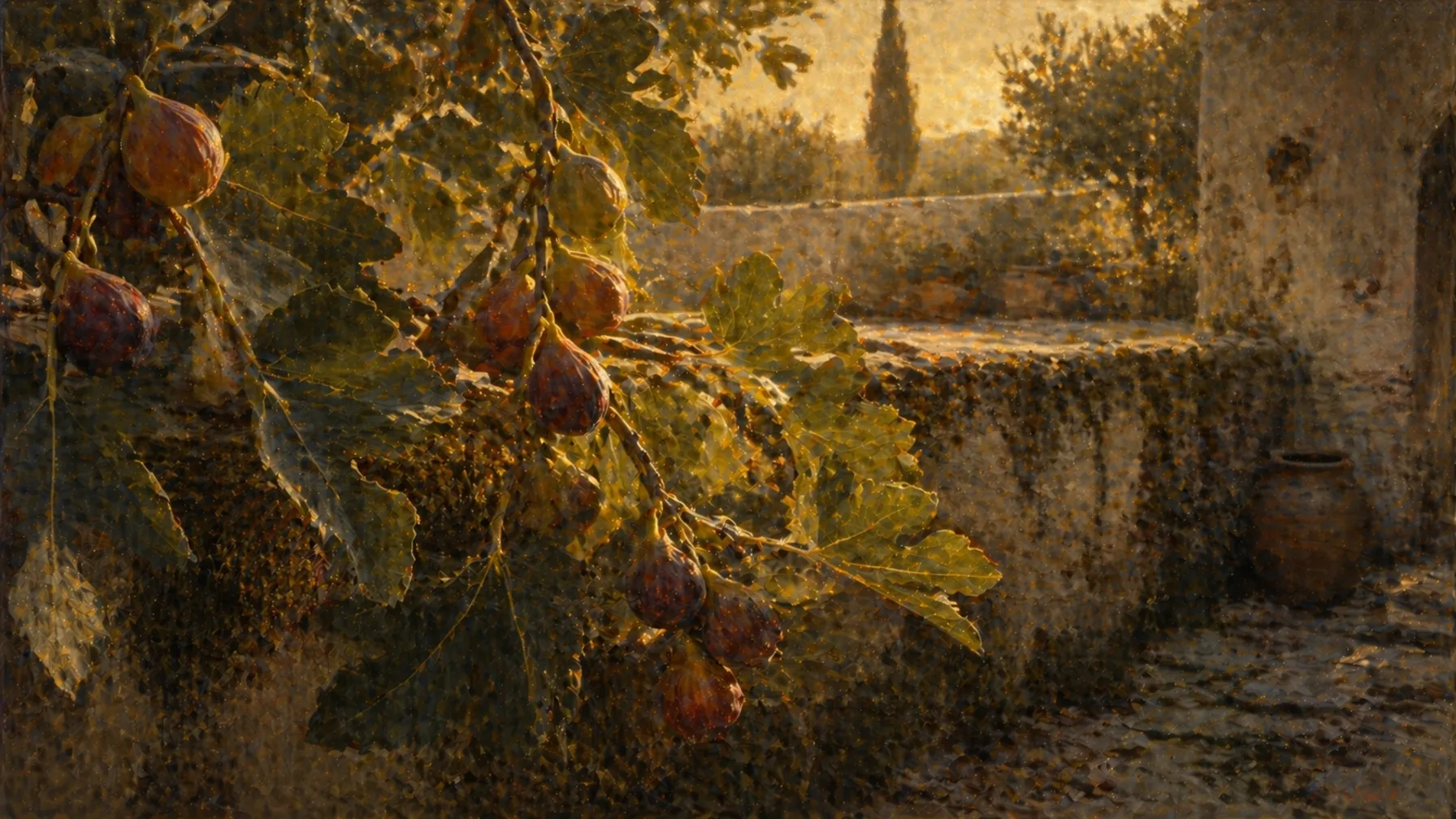
Paul writes fruit in the singular against works of the flesh in the plural, and the grammar carries the point: one cluster growing together rather than nine traits to collect separately. Love heads the list because 1 Corinthians 13 makes it the more excellent way. The agricultural image is itself the argument, since fruit appears slowly and only where the vine is tended.
Ask most Christians what the gifts of the Spirit are and they will give you a list. Ask them what the fruit of the Spirit is and they will give you a different list, nine items long, usually recited from memory as if they were values on a poster. Both answers miss what Paul is actually saying. He does not write about the fruits of the Spirit. He writes about the fruit, singular, one organic whole produced by one source in one person's character over time. That distinction carries more weight than it first appears.
One cluster, not nine separate items
Paul sets the list in Galatians 5:22-23 against the contrasting catalogue of "the works of the flesh" in verses 19-21. The contrast is deliberate. Works is plural. Flesh produces multiple, competing, self-generated acts. Fruit is singular. The Spirit produces a single coherent character. Where flesh fractures, the Spirit integrates.
Nine qualities are named: love, joy, peace, patience, kindness, goodness, faithfulness, gentleness, self-control. They are not nine independent virtues a Christian acquires one by one. They belong to each other. A person genuinely growing in patience will also be growing in gentleness, because the same root is feeding both. A person who claims love but shows no kindness has not yet understood what love means in Paul's vocabulary.
Love as the root
First Corinthians 13 explains why love heads the list. Paul does not say love is the greatest of the gifts. He says it is the "more excellent way" (1 Corinthians 12:31) and spends a full chapter showing that every other quality, separated from love, becomes hollow. Tongues without love is noise. Knowledge without love inflates. Sacrifice without love profits nothing.
What Paul describes in 1 Corinthians 13:4-7 is not love as emotion but love as character: patient, kind, not envious, not arrogant, not irritable. Read it beside the Galatians 5 list. The overlap is not accidental. Paul is describing the same person from two different angles. Joy, peace, patience, kindness, goodness, faithfulness, gentleness, and self-control are what love looks like when it takes up residence in a human life. Love is the root. The rest are what breaks ground above the soil.
Character before charisma
This matters most in conversations about spiritual gifts. Continuationist and cessationist traditions argue about which gifts are still active. They rarely argue about Galatians 5:22-23, because Paul does not present the fruit as a distinctive of any tradition. He presents it as the non-negotiable evidence of the Spirit's work in any Christian life, in any century, in any church.
Romans 8:5-6 puts it plainly: "to set the mind on the Spirit is life and peace." Paul is not describing a second tier of experience reserved for those who speak in tongues or see visions. He is describing ordinary Christian life oriented by the Spirit. That orientation produces character. Character, not charisma, is what the New Testament returns to when it asks how you recognize genuine spiritual formation.
Why fruit takes time
The agricultural image is itself the argument. Fruit does not appear overnight. A farmer who plants a vine in spring does not look for grapes in a week. The clusters come when the vine is tended and conditions are right.
Jesus makes the mechanics explicit in John 15:1-8. "I am the true vine, and my Father is the vinedresser. Every branch in me that does not bear fruit he takes away, and every branch that does bear fruit he prunes, that it may bear more fruit" (John 15:1-2). The branch does not produce fruit by trying harder. It produces fruit by remaining. "Abide in me, and I in you. As the branch cannot bear fruit by itself, unless it abides in the vine, neither can you, unless you abide in me" (John 15:4). The fruit is not the achievement of the branch. It is the result of connection.
This reframes sanctification. The question is not "how do I become more patient?" It is "am I staying connected to the one who is the source of patience?" Straining after individual virtues while neglecting the vine produces the grinding, performance-oriented faith Paul contrasts with Spirit-produced fruit. The works of the flesh include religious effort severed from the Spirit. The fruit of the Spirit includes patience that no human willpower could sustain alone.
Flesh and Spirit: the frame Paul provides
Galatians 5:19-21 lists what the flesh produces when it runs unchecked: sexual immorality, impurity, sensuality, idolatry, sorcery, enmity, strife, jealousy, fits of anger, rivalries, dissensions, divisions, envy, drunkenness, carousing. Paul is not only cataloguing vices. He is showing that life in the flesh fragments. The works of the flesh divide people from God, from one another, and from the coherence of their own selves.
The fruit of the Spirit does the opposite. It integrates. Colossians 3:12-14 pictures the same cluster as clothing to be put on, and then names love as what "binds everything together in perfect harmony." The binding word is love again. Hold it back and the other qualities slip loose from one another.
Equally available, equally required
Paul wrote Galatians to churches under pressure from teachers who said Gentile converts needed circumcision to be fully Christian. His argument is that the Spirit, not the law, is the power behind genuine obedience. "But if you are led by the Spirit, you are not under the law" (Galatians 5:18). The fruit that follows is not the achievement of the morally disciplined. It is the natural yield of the person indwelt by the Spirit of God.
That makes the fruit equally available to the new believer and the mature one, to the village church and the seminary, to the cessationist and the continuationist. No tradition has exclusive claim on it. None is exempt from it. Where it is absent over time, something has gone wrong at the root, no matter how impressive the gifts or the activity.
The long work
Fruit develops. It does not arrive. The Christian who wants love, joy, peace, patience, kindness, goodness, faithfulness, gentleness, and self-control to mark their life is not looking for a single transforming experience, though the Spirit may work through acute moments of grace. They are looking for a sustained life of abiding: Scripture, prayer, community, repentance, worship. The vine does the work. The branch's task is to stay connected.
What should give both comfort and honest pause is Paul's closing phrase in Galatians 5:23: "against such things there is no law." No external rule produces this character. No program installs it. The person whose life shows this cluster has not out-disciplined anyone. They have stayed close to the vine long enough for the vine to bear fruit through them. That is a different kind of formation entirely.
Ask your group to take one quality from the list and name a person in their life, living or dead, in whom they have watched that quality grow visibly over years. Then ask what they notice about how that person relates to God.
Terms in this article
Every passage each one appears in, with the definition attributed to its source.
Keep reading
Doctrine of God
Union with Christ
Forgiveness, justification, adoption and the Spirit are not separate items. What Paul's 160 uses of "in Christ" say about how they hold together.

Doctrine of God
The Person of the Spirit
The Spirit is a person, not an atmosphere. What he does that only persons do, why Acts 5 settles his deity, and why the pronoun matters.
Doctrine of God
The Work of Christ
Prophet, priest and king are not three phases of Jesus's life. All three offices are active now, which is what the ascension actually means.


