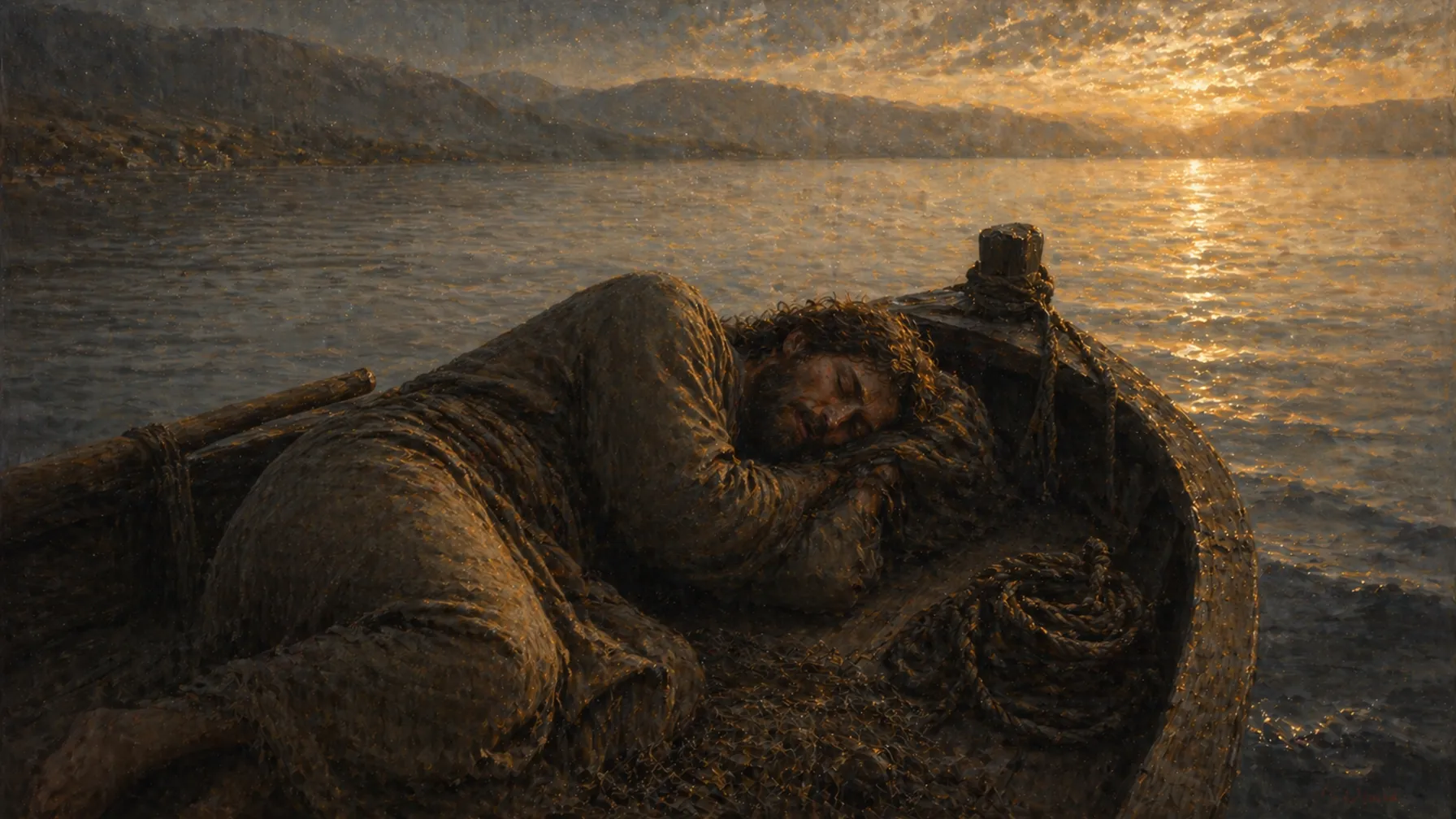
The humanity of Jesus is not incidental detail. He sat at the well because he was wearied (John 4:6), he was hungry after the fast, and he wept at Lazarus's tomb. Hebrews 4:15 says he was tempted in every respect as we are, yet without sin. Chalcedon in 451 stated the shape: one person in two complete natures, because he had to become what we are to redeem it.
It was noon, and Jesus sat down. Not paused. Sat. John tells us he was "wearied from his journey" when he stopped at Jacob's well in Samaria (John 4:6). His disciples had gone into town to buy food, so he was hungry too. He had been walking. His legs ached. His mouth was dry. When the Samaritan woman arrived, he asked her for a drink because he needed one. This is the Son of God. This is what the incarnation looks like from the inside.
He sat down because he had to
The physical humanity of Jesus is not incidental color in the Gospels. It is load-bearing. After forty days of fasting in the wilderness, Matthew records simply that Jesus "was hungry" (Matthew 4:2). Not spiritually depleted. Hungry. He slept in the stern of a boat during a storm severe enough to terrify experienced fishermen (Mark 4:38). He asked the disciples at Caesarea Philippi what people were saying about him (Mark 8:27). These are not literary devices. They are what a real body in a real world requires.
Paul captures the shape of it in Philippians 2: the Son "emptied himself, by taking the form of a servant, being born in the likeness of men" (Philippians 2:7). The Greek word translated "emptied" is kenosis. He did not disguise himself as human. He took on a genuine human nature with its genuine limitations. Tiredness. Thirst. The need to eat.
He wept
The shortest verse in the Bible is also one of the most theologically dense. "Jesus wept" (John 11:35). Lazarus had died. Mary was devastated. The crowd was weeping. Jesus, standing before the tomb of his friend, was "deeply moved in his spirit and greatly troubled" (John 11:33). Grief ran through him. Not a simulation of grief. Not a pastoral performance to comfort the mourners. Real grief, the kind that makes the chest tight and the eyes fill.
His development was equally real. Luke records that as a boy Jesus "increased in wisdom and in stature and in favor with God and man" (Luke 2:52). He learned. He grew. In his human nature he acquired knowledge the way every human child does, by living, listening, reading, and being taught. This is not a contradiction of his divinity. It is what the incarnation required.
Tempted in every way
Hebrews draws the starkest line in the New Testament on this point. Jesus was "one who in every respect has been tempted as we are, yet without sin" (Hebrews 4:15). Not tempted in the abstract. Not tempted symbolically. In every respect. The temptations in the wilderness were real, not theatrical tests staged for our benefit. Hunger, power, and the desire for an easier path all pulled at him. He felt the pull. He resisted it.
This is why the same passage tells us to approach the throne of grace "with confidence" (Hebrews 4:16). The high priest who intercedes for us is not a distant divine figure who managed humanity from a safe remove. He carried it from inside. Whatever you are facing right now, he has faced the category.
Born of a woman
The angel told Mary that "the Holy Spirit will come upon you, and the power of the Most High will overshadow you; therefore the child to be born will be called holy, the Son of God" (Luke 1:35). Two things are secured simultaneously by the virgin birth. First, his genuine humanity: he was born of a woman, carried in a womb, delivered as every human being is. He entered history the way we all do. Second, his sinlessness: conceived by the Spirit rather than by ordinary generation, he did not inherit the sin that passes through human descent. Holy from conception.
Strip out the virgin birth and both things collapse. A Jesus with an ordinary human father has no obvious mechanism for sinlessness, and a Jesus who dropped into the world fully formed without a mother has no genuine humanity. The doctrine is not a concession to mythology. It is the precise mechanism the incarnation required.
One person, two natures
The Council of Chalcedon in 451 AD gave the church its most precise formulation: Jesus Christ is one person in two complete natures, fully divine and fully human, "without confusion, without change, without division, without separation." The divine nature was not diluted by becoming human. The human nature was not absorbed into the divine. Both remain complete and distinct in the one person of the Son.
This is what theologians call the hypostatic union. It is not a compromise between two half-natures. Jesus was not half God and half man, some hybrid in between. He was the fullness of God in the fullness of humanity. When he wept at Lazarus' tomb, his human nature wept. When he raised Lazarus from the dead, his divine power raised him. Both actions came from the same person.
He had to become what we are
Hebrews 2 is the clearest statement in the New Testament of why the incarnation had to happen the way it did. "Since therefore the children share in flesh and blood, he himself likewise partook of the same things, that through death he might destroy the one who has the power of death" (Hebrews 2:14). He had to share our flesh because only by dying as a human being could he defeat death for human beings. A purely divine Son could not have died. A purely symbolic humanity would have produced only a symbolic death.
The passage presses further. He became like us "in every respect, so that he might become a merciful and faithful high priest in the service of God, to make propitiation for the sins of the people" (Hebrews 2:17). Two things required his full humanity: the sacrifice and the sympathy. The sacrifice, because the priest had to be human to represent humanity before God. The sympathy, because he "himself has suffered when tempted, he is able to help those who are being tempted" (Hebrews 2:18).
The humanity of Christ is not a footnote to the gospel. It is the mechanism by which the gospel works. He could not have redeemed what he had not become. He could not have represented us if he had not joined us. The weariness at the well, the hunger in the wilderness, the tears outside the tomb. These are not limitations to apologize for. They are the shape of our salvation.
Ask your group this week to sit with Hebrews 4:15-16 and identify one specific temptation or struggle they are currently facing, then discuss what it means to bring that exact thing to a high priest who has been tempted in the same category.
Terms in this article
Every passage each one appears in, with the definition attributed to its source.
Keep reading

Doctrine of God
The Work of Christ
Prophet, priest and king are not three phases of Jesus's life. All three offices are active now, which is what the ascension actually means.

Doctrine of God
The Trinity
One God in three persons, from the texts rather than the councils. Where the doctrine starts, and what it changes about prayer and salvation.

Doctrine of God
The Person of the Spirit
The Spirit is a person, not an atmosphere. What he does that only persons do, why Acts 5 settles his deity, and why the pronoun matters.


