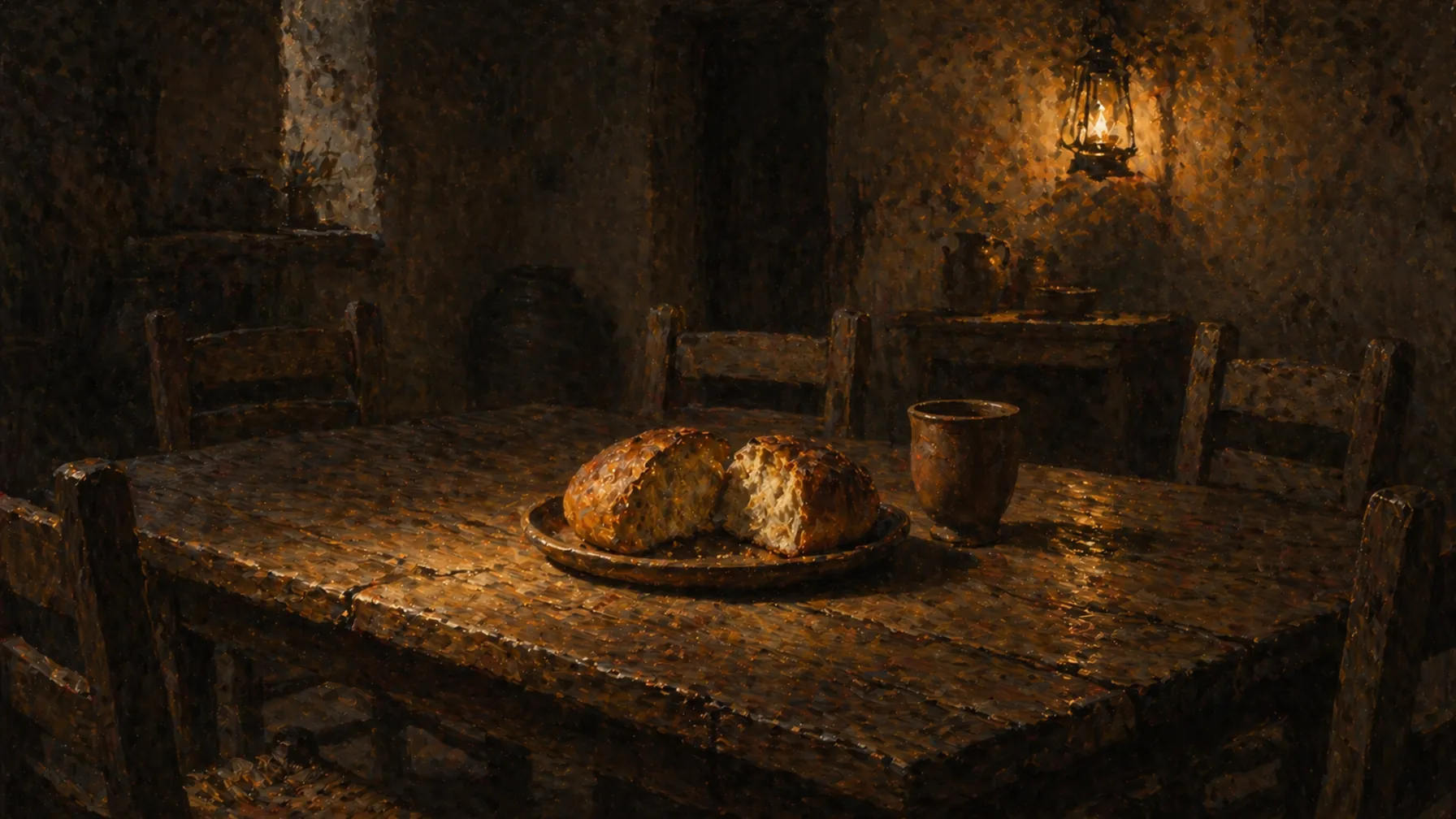
Before any tradition interprets it, 1 Corinthians 11:23-26 gives the Supper its shape: instituted by Christ, received and handed on, and a proclamation of his death until he comes. Catholic, Lutheran, Reformed and memorialist readings differ over presence, and those differences were sharp enough to divide churches. All four hold that Christ instituted it and that the table proclaims his death.
Picture a first-century church gathering in someone's house. There is no building, no order of service. Bread is broken and passed. A cup follows. Someone reads aloud Paul's reminder that the Lord himself gave these words: "Do this in remembrance of me" (1 Cor 11:24, ESV). That room held no theological consensus about what exactly was happening in that moment. What it held was obedience and the proclamation of a death that changed everything.
Christians have argued about the Lord's Supper for five centuries and have not resolved the argument. What follows is not a verdict. It is a map of the terrain, so that when you sit at the table, you know what you are holding and why it matters more than most people in the pew realize.
What the texts establish
Before any tradition interprets the Supper, the New Testament gives it a shape. Paul writes in 1 Corinthians 11:23-26 that he "received from the Lord what I also delivered to you" and that Jesus took bread, gave thanks, broke it, and said, "This is my body, which is for you. Do this in remembrance of me." The same sequence follows with the cup: "This cup is the new covenant in my blood. Do this, as often as you drink it, in remembrance of me." Real bread. Real cup. A command that is given not to individuals but to a gathered community.
Paul adds the weight of proclamation in verse 26: "For as often as you eat this bread and drink the cup, you proclaim the Lord's death until he comes." The table is not a private devotion. It is a communal announcement, spoken in bread and wine to a watching world, that a death happened and that the one who died is coming back.
Then 1 Corinthians 10:16 pushes further: "The cup of blessing that we bless, is it not a participation in the blood of Christ? The bread that we break, is it not a participation in the body of Christ?" The Greek word is koinonia: communion, sharing in. Whatever view one holds, Paul does not treat the Supper as a bare sign pointing to an absent referent. He treats it as real participation in Christ's death.
Four readings of the same table
Roman Catholic theology holds that the bread and wine are substantially transformed into Christ's body and blood at consecration. The accidents of bread and wine remain; the underlying substance changes. This is transubstantiation, defined at the Fourth Lateran Council in 1215 and reaffirmed at Trent. The result is that Christ is present in the fullest bodily sense: to receive the eucharist is to receive him entirely. Luke 22:19-20 and Matthew 26:26-28 are read at face value: "This is my body." Literally so.
Lutheran theology agrees that Christ's body and blood are truly present, but refuses to speculate about the mechanism. Luther held that Christ is present "in, with, and under" the bread and wine without the substances being destroyed or changed. Consubstantiation is the traditional label, though Luther himself rejected it. The Supper is not a bare symbol. Christ's words "This is my body" are received as direct, not metaphorical, and the body and blood are truly eaten and drunk.
Reformed and Calvinist theology affirms real presence but locates it differently. Calvin argued that the body of Christ is at the Father's right hand and cannot be locally present in the bread. The Spirit, however, lifts believing hearts to Christ and unites them to him. The Supper is therefore a real means of grace, not a bare memorial, but the mode of presence is spiritual rather than physical. The koinonia of 1 Corinthians 10:16 is taken seriously. The Lutheran mode of bodily presence is not.
Zwinglian or memorialist theology, which became the dominant view in much of evangelical and Baptist Christianity, reads "This is my body" as "This signifies my body." The Supper is a commemorative ordinance, a sign enacted by the congregation to declare their faith in Christ's atoning death. It does not convey grace. It symbolizes grace already received. The focus falls on 1 Corinthians 11:26: "you proclaim." The proclamation is the point, not any mode of presence in the elements.
Where all four agree
The arguments between these views have been sharp enough to divide churches and, in the sixteenth century, to prevent Protestant unity. That history should not be minimized. But each view shares more than it often admits.
All four hold that Jesus instituted the Supper. Not the church, not a council. Jesus, on the night he was betrayed, took bread and cup and commanded the act. All four hold that it involves real bread and a real cup, not an abstraction. All four hold that it is a proclamation of his death, directed toward the second coming. All four receive 1 Corinthians 10:16 as authoritative, even if they differ on what "participation" means in practice. The dispute is genuine, but it is a dispute among people who agree that this table is Christ's, that it looks backward to his cross and forward to his return, and that it was given to the church as a commanded act, not an optional supplement.
The pastoral weight of the table
Churches sometimes reduce the Supper to a quarterly footnote or treat it with so little preparation that Paul's warning in 1 Corinthians 11:27-29 becomes invisible: eating and drinking "without discerning the body" is treated by Paul as a serious failure, not a minor liturgical slip. He connects careless practice at the Corinthian table with illness and death in the congregation. Whether or not one reads that connection literally, the intent is plain: the table carries weight.
That weight is not primarily doctrinal. It is communal and christological. This is a meal that forms the people who eat it. Matthew 26:28 places the cup explicitly in the logic of the new covenant: "this is my blood of the covenant, which is poured out for many for the forgiveness of sins." To receive it is to be placed, again and again, in the event of that forgiveness. It is to declare publicly that you are not self-sufficient, not only a moral agent, but a person whose only standing before God is Christ's body given and blood poured. The bread and the cup do not let you be abstract about that. You eat. You drink. The body remembers what the mind forgets.
Your tradition will shape how you understand what is happening in the elements. No tradition excuses passivity at the table. Before you lead your group to the text this week, ask them what would change about how we practice the Supper if we took 1 Corinthians 11:26 as its primary description.
Terms in this article
Every passage each one appears in, with the definition attributed to its source.
Keep reading

Bible Study
How to Read Revelation: The Four Main Interpretations
Preterist, historicist, futurist and idealist. What each framework claims, where each is strongest, and why sincere readers reach different conclusions.
Doctrine of God
Four Gospels, One Christ
Tatian merged the four Gospels into one and the church rejected it. What each writer emphasizes, and why four accounts strengthen the case.

Bible Study
Discipline and Restoration
Matthew 18 and 1 Corinthians 5 handle different cases. What church discipline is actually for, and the two opposite ways it collapses.


