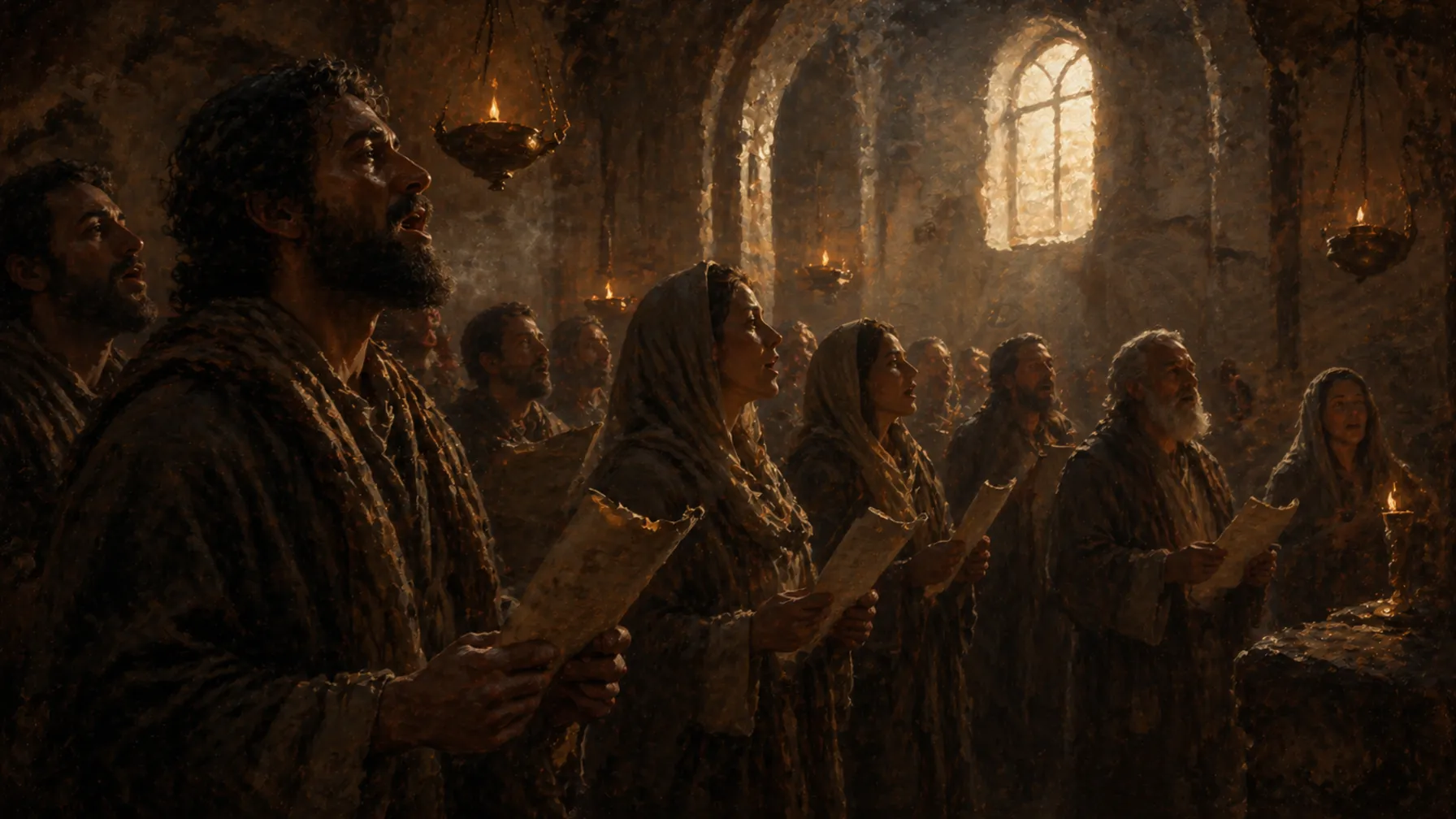
Nehemiah 8 shows the shape of Word-centered gathering: the scroll opened in public, read aloud, explained, and responded to. The elements that follow are ordinary and load-bearing. Public reading, prayer offered together, singing that Paul frames as mutual instruction, the Supper as communal proclamation, and giving treated as worship rather than logistics.
Picture the square before the Water Gate in Jerusalem, sometime in the fifth century before Christ. Ezra the scribe stands on a wooden platform. The whole assembly is there: men, women, and children old enough to understand. He opens the scroll and reads from early morning until midday. The people listen. When he finishes a section, the Levites spread through the crowd and explain what was just heard, "so that the people understood the reading" (Nehemiah 8:8, ESV). Most of what happens in that scene still happens on a Sunday morning.
The reading that cannot be skipped
Nehemiah 8:1-8 is a portrait of Word-centered corporate worship. The scroll is opened in public, read aloud, and explained, and the people respond. Paul gives Timothy a similar charge in a different century: "devote yourself to the public reading of Scripture, to exhortation, to teaching" (1 Timothy 4:13). Public reading is listed first. The text has to be heard, not just summarized. Later, in his last letter, Paul sharpens it: "preach the word; be ready in season and out of season; reprove, rebuke, and exhort, with complete patience and teaching" (2 Timothy 4:2).
A gathering that fills its hour with everything except the read and preached Word is missing the main thing. Every tradition that takes Scripture seriously knows this, whether the setting is a cathedral with a lectionary or a rented school gym working through Romans.
Praying together
After Peter and John were released from custody, they didn't go home to pray alone. They "went to their friends and reported what the chief priests and elders had said to them. And when they heard it, they lifted their voices together to God" (Acts 4:23-24). The prayer in Acts 4:24-31 is long, specific, and spoken in one voice by many people. It quotes Psalm 2. It names the political situation. It asks for boldness rather than safety. The room shakes.
Paul instructs Timothy that "supplications, prayers, intercessions, and thanksgivings be made for all people, for kings and all who are in high positions" (1 Timothy 2:1-2). That instruction is given to a gathered church, not to individuals praying in isolation. Corporate prayer puts many voices on one address and makes a community say out loud, together, what it actually believes and needs.
Songs that teach
Corporate singing isn't a warm-up for the sermon. Paul frames it as mutual instruction: "Let the word of Christ dwell in you richly, teaching and admonishing one another in all wisdom, singing psalms and hymns and spiritual songs, with thankfulness in your hearts to God" (Colossians 3:16). Teaching and admonishing happen through the singing. The congregation isn't an audience watching musicians perform. Each person is addressed by the others and addresses them back.
Ephesians 5:19 makes the direction explicit: "addressing one another in psalms and hymns and spiritual songs, singing and making melody to the Lord with your heart." The song goes upward to God and across the room at the same time. What a congregation chooses to sing shapes what it believes. The theology in the room on a given Sunday is often closer to the hymn texts than to the sermon outline.
Bread and cup as public declaration
The Lord's Supper isn't private devotion done near other people. Paul writes that "as often as you eat this bread and drink the cup, you proclaim the Lord's death until he comes" (1 Corinthians 11:26). The table is a communal announcement. A congregation eating and drinking together declares, to itself and to anyone watching, that a death happened and that the one who died is returning. One person eating alone in a room cannot do what a gathered church does when bread and cup are shared across rows of people who are betting their lives on the same death and the same return.
The offering as worship
Financial giving tends to get treated as a logistical necessity rather than as worship. Paul corrects that assumption when he writes to Corinth about the collection for the saints: "Each one must give as he has decided in his heart, not reluctantly or under compulsion, for God loves a cheerful giver" (2 Corinthians 9:7). The standard is the condition of the heart, not the size of the gift. Giving with the assembly is worship. It is the congregation placing material things on the altar together, saying that nothing in their hands belongs to them alone.
What private devotion cannot do
The case for gathering doesn't rest on guilt. It rests on what is actually possible when the body assembles. Hebrews puts it directly: "not neglecting to meet together, as is the habit of some, but encouraging one another, and all the more as you see the Day drawing near" (Hebrews 10:25). The neglect being warned against was already a habit for some in that congregation. The reason given for gathering isn't duty. It is mutual encouragement in light of the Day that is coming.
The New Testament is dense with one-another commands: love one another, bear one another's burdens, confess to one another, pray for one another, forgive one another, instruct one another. Every one of them needs another person in the room. Private devotion can sustain a soul. It cannot do what those commands ask, because each one assumes someone else is there with you. The person who replaces Sunday gathering with a podcast and a quiet morning hasn't found a better form of church. They have stepped outside the shape of it.
Across liturgical and free-church traditions, the same elements show up even when the forms look nothing alike. A high Anglican service and a small non-denominational storefront church both read Scripture, pray, sing, and come to the table. The forms differ; the pieces are the same. These elements weren't invented by a council or a denomination. They were given by apostolic pattern and repeated in every generation because the church kept finding, every time, that nothing else would do the work.
This week, take your group through Hebrews 10:24-25 and ask which specific "one another" in your congregation would go unmet if each of you simply stopped showing up.
Terms in this article
Every passage each one appears in, with the definition attributed to its source.
Keep reading

Leading and Teaching
What the Church Is
Body, bride, household, temple. Four New Testament images for the church, and what each says that "I can worship anywhere" cannot.

Leading and Teaching
Marks of the Church
Luther and Calvin named two marks of a true church. Acts 2:42 describes four. What the marks are for, and why asking about them is pastoral.

Doctrine of God
The Person of the Spirit
The Spirit is a person, not an atmosphere. What he does that only persons do, why Acts 5 settles his deity, and why the pronoun matters.


