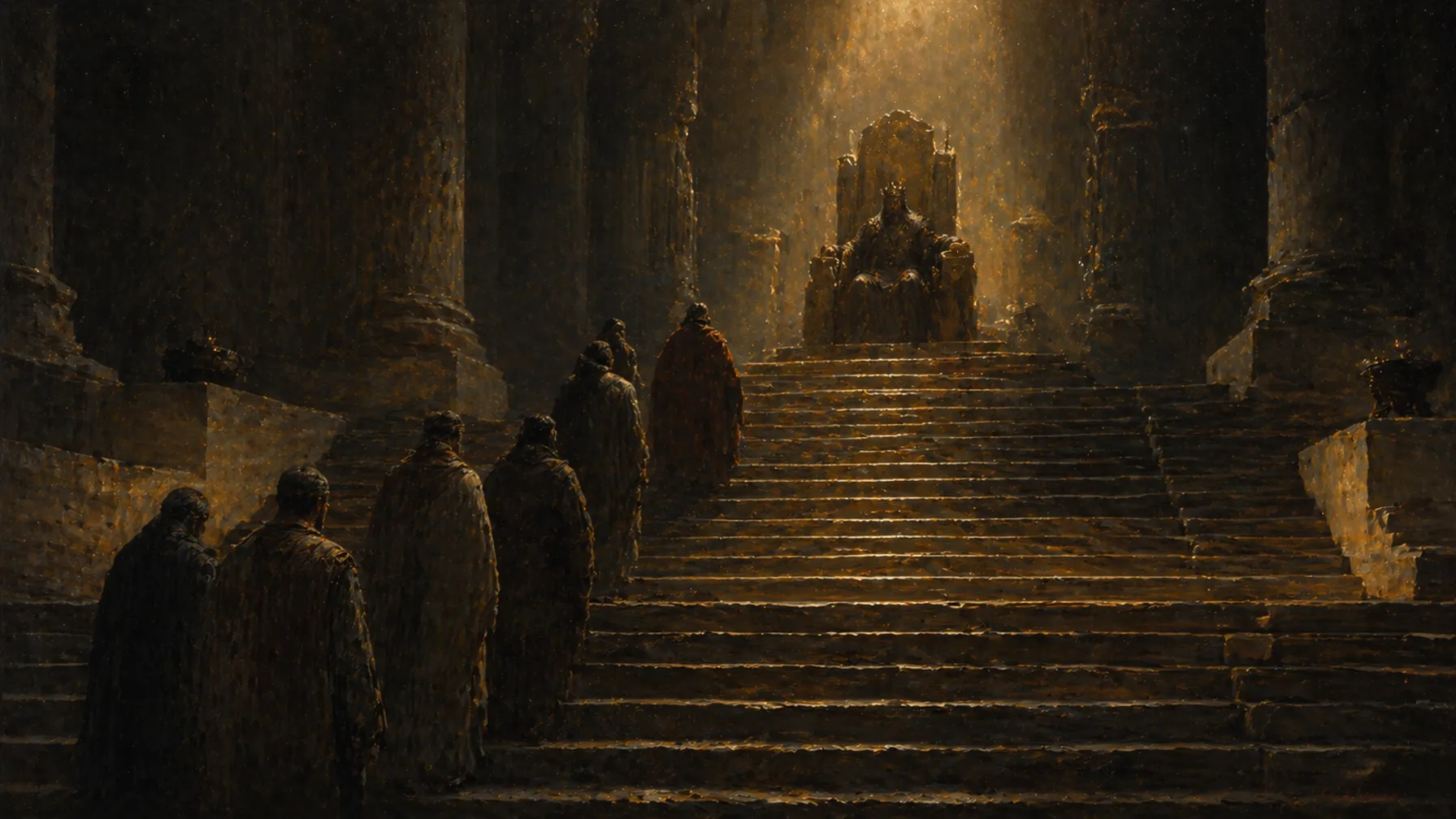
Acts 2:23 holds both together in a single sentence: Jesus was delivered up by God's definite plan and foreknowledge, and the crowd crucified him by their own hands. Scripture asserts sovereignty and responsibility side by side without treating them as a problem to solve. The biblical writers do not appear to feel the tension the way modern readers do.
Peter stood before a crowd that had watched Jesus die five weeks earlier. Some of them had been there. Some had shouted. And now Peter said something that should have stopped the sermon cold: "this Jesus, delivered up according to the definite plan and foreknowledge of God, you crucified and killed by the hands of lawless men" (Acts 2:23). One sentence, two agents. God's definite plan and human lawless killing, side by side. Peter did not feel the tension enough to pause. He said it and moved on.
That is where this topic begins. Not in a philosophy seminar but in a public accusation, where the most morally freighted event in history is attributed at once to divine purpose and human guilt. If you can sit with Acts 2:23 without reaching for a resolution too quickly, you are ready for what follows.
What Scripture plainly teaches about divine sovereignty
The biblical portrait of God's sovereignty is not a philosophical inference. It is a running claim across both Testaments. Isaiah 46:10 records God saying, "my counsel shall stand, and I will accomplish all my purpose." Not most of it. Not the broad strokes. All of it. Proverbs 19:21 puts the same truth at street level: "Many are the plans in the mind of a man, but it is the purpose of the Lord that will stand."
The Joseph narrative gives this doctrine a face. His brothers sell him into slavery. They mean it as destruction. Decades later, Joseph tells them: "you meant evil against me, but God meant it for good, to bring it about that many people should be kept alive" (Genesis 50:20). The same act, two meanings, both real. God was not reacting to the brothers' sin and making the best of a bad situation. He was governing through it toward a predetermined end, and the brothers never stopped being morally responsible for what they chose.
Isaiah 10 presses this further. Assyria is called "the rod of my anger" (Isaiah 10:5), an instrument God wields against a disobedient Israel. Assyria is at the same time condemned for its pride and arrogance, for it "did not intend so, and its heart did not think so" (Isaiah 10:7). The nation pursued conquest for its own imperial ambitions, not for God's purposes. It will be judged for that. The text never suggests the two claims cancel each other. God used Assyria. Assyria was guilty. Both fully true.
What Scripture plainly teaches about human responsibility
Responsibility without real choice is a legal fiction, and Scripture shows no interest in legal fictions. When Jesus says "Come to me, all who labor and are heavy laden, and I will give you rest" (Matthew 11:28), the call assumes people can respond or refuse. When Moses sets before Israel "life and good, death and evil" and commands them to "choose life" (Deuteronomy 30:15, 19), the command is not theatrical. The exile that follows their disobedience is not theater either.
John 6 holds both claims inside a single passage. Jesus says, "All that the Father gives me will come to me" (John 6:37). The giving is the Father's sovereign act. In the same chapter he turns to address those who reject him: "you have seen me and yet do not believe" (John 6:36). A few verses later: "No one can come to me unless the Father who sent me draws him" (John 6:44). The coming is sovereignly enabled. The refusal is genuinely culpable. Jesus treats both as operative at once. He does not harmonize them. He states them.
Philippians 2:12-13 may be the most concentrated statement of the tension in the New Testament. Paul writes: "work out your own salvation with fear and trembling, for it is God who works in you, both to will and to work for his good pleasure." Human effort is commanded and demanded. Divine causation is given as the reason for that effort. The logic is not: God works, therefore you need not. It is: God works, therefore you work. The sovereignty is the ground of the command, not its replacement.
Two readings, two strong cases
The Calvinist reading holds that God's decree is primary in a specific sense: God determines not only the outcomes but the inclinations by which people reach them. On this reading, the will is genuinely free in the compatibilist sense you always do what you most want to do but what you want is itself shaped by what God has ordained. Election is unconditional, grounded in God's sovereign choice rather than foreseen faith. Human responsibility remains real because people act from their own desires; accountability does not require that those desires could have been otherwise. The strength of this reading is its grip on texts like Ephesians 1:4-5, where Paul says believers were "chosen in him before the foundation of the world" and "predestined for adoption." It also handles Genesis 50:20 and Isaiah 10 with particular coherence: God ordains through secondary causes without those causes becoming mere puppets.
The Arminian reading insists that genuine responsibility requires libertarian freedom: the real ability to have chosen otherwise in the same circumstances. Without that, praise and blame lose their ordinary meaning. God, on this account, foreknows what people will freely choose but does not causally determine those choices. Prevenient grace enables the will to respond, making faith genuinely possible, but the response is the person's own. This reading draws on texts like 2 Peter 3:9, where God is "not wishing that any should perish, but that all should reach repentance," and 1 Timothy 2:4, where God "desires all people to be saved." If God determines who will be saved and yet some perish, something has gone unfulfilled in the divine will. The Arminian argues that a God of genuine love must allow genuine rejection. The weight of gospel invitations, the real pathos of Jesus weeping over Jerusalem (Luke 19:41), and the language of human "hardening" themselves against God (Zechariah 7:11-12) all point in this direction.
Both traditions have been held by serious, Scripture-saturated theologians across five centuries. Neither has produced a knockdown argument that the other cannot answer. That is worth pausing over.
Why Scripture leaves the tension standing
One honest move is to ask whether the demand for a resolution is itself the problem. The biblical writers do not seem to feel the tension as the acute logical contradiction modern readers feel it to be. Peter in Acts 2 states both sides without apology. Paul in Romans 9 moves from the strongest statement of sovereign election anywhere in the New Testament directly into a chapter that addresses human responsibility (Romans 10:9-13). He does not say, "I realize these look contradictory; here is how to reconcile them." He says both and trusts the reader to hold them.
Part of the reason may be that Scripture is less interested in explaining the mechanism of divine and human agency than in preserving the reality of both. God must be sovereign, otherwise the cross is an accident and history is noise. Humans must be responsible, otherwise judgment is injustice and the gospel call is a performance. Lose either and you have a different religion. Keep both and you have something that exceeds any grid we bring to it.
Augustine put it one way. Arminius put it another. Neither resolved the paradox completely, because the paradox may be a feature of divine transcendence rather than a theological loose end waiting for a sharper mind to tie it off. God's ways are "past finding out" (Romans 11:33). That verse follows the most sustained treatment of election in the New Testament. Paul's response to his own argument is doxology, not a fifth point.
This does not mean the question is unimportant or that the two readings are equally defensible on every text. It means that whatever position your group holds, it should be held with the awareness that the other side is reading the same Bible carefully and finding real warrant there. The text keeps both weights on the scale at once.
For your Tuesday-night group: read Acts 2:23 alongside Genesis 50:20 and ask each person to name which side of the tension they find hardest to hold then spend the rest of the time in those texts rather than in the systematic positions.
Terms in this article
Every passage each one appears in, with the definition attributed to its source.
Keep reading

Bible Study
Bible Journaling for Beginners: A Study Page to Copy
Start a Bible study journal with a completed note from Philippians 1. Use a simple page layout for observations, questions, and a response.

Bible Study
Bible Study for Couples: A First Session Together
Try a Bible study together with a 20-minute session on Colossians 3. Includes questions, a simple agenda, and guidance for dating or married couples.

Bible Study
Bible Study for Men: Three Sessions on Everyday Conduct
Use three Bible studies for men on speech, ambition, and generosity. Each includes a passage, discussion questions, and a concrete personal response.


