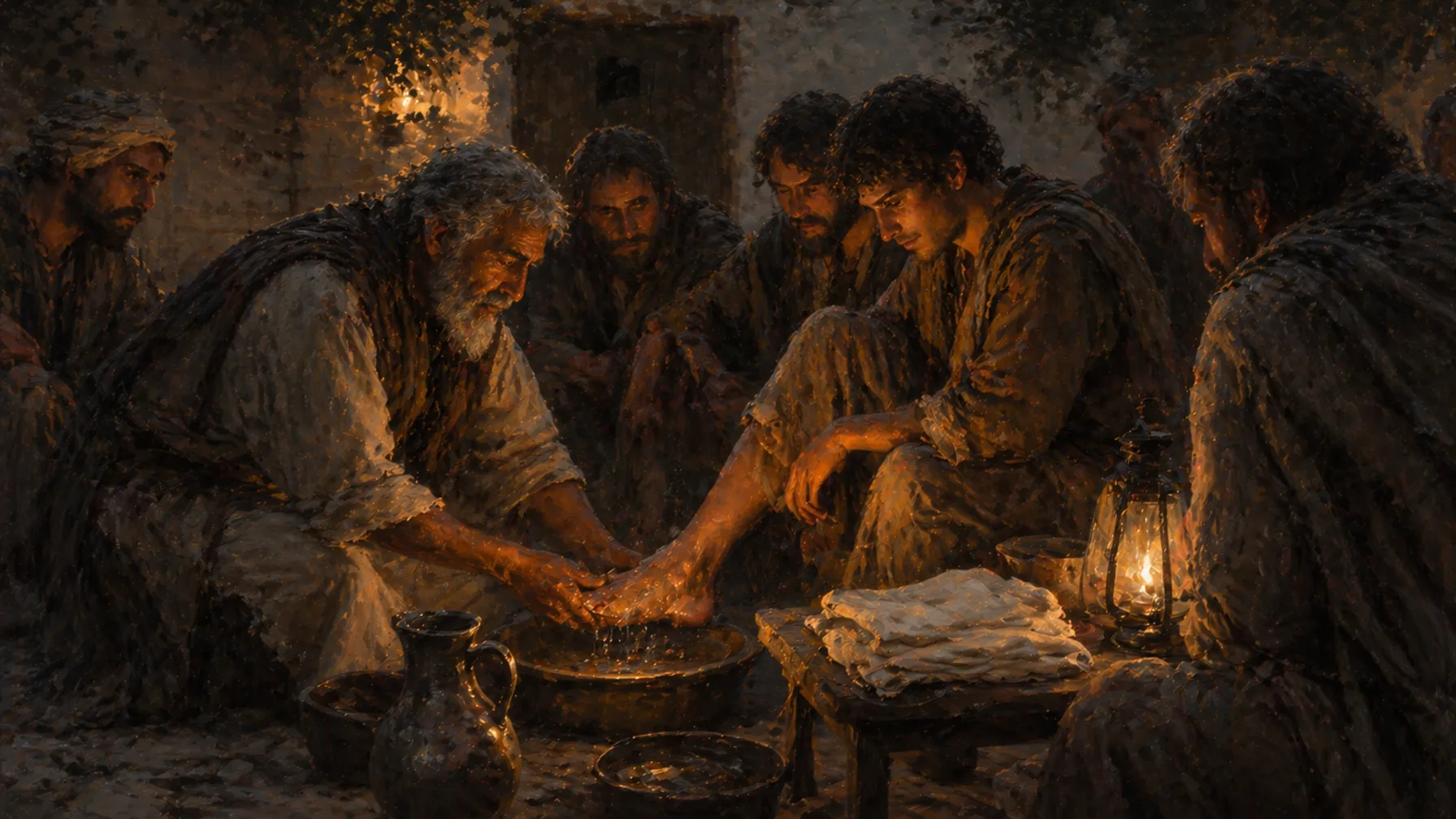
The New Testament uses elder, overseer and shepherd for a single office, which Acts 20 shows by applying all three to the same men. Paul's lists in 1 Timothy 3 and Titus 1 weigh character far more than competence. Deacons emerged from a practical crisis in Acts 6 so the apostles could stay with prayer and the Word.
Picture a congregation in Crete, perhaps forty years after the resurrection. Paul has passed through, the Spirit has moved, people have believed. But something is wrong. False teachers have slipped in. Households are being disrupted. Doctrine is drifting. Paul writes to Titus with a single urgent commission: "This is why I left you in Crete, so that you might put what remained into order, and appoint elders in every town as I directed you" (Titus 1:5, ESV). The disorder Paul sees has a structural remedy. That is not incidental. It is the argument.
One role, three names
The New Testament uses three terms for the same office: elder (presbyteros), overseer (episkopos), and shepherd or pastor (poimen). They are not three separate positions stacked in a hierarchy. Acts 20 makes that plain. Paul summons the elders (presbyterous) of Ephesus and then speaks to them as overseers (episkopous) who are to shepherd (poimainein) the flock (Acts 20:17, 28). Same group, three descriptions. Elder names the person. Overseer names the function of watching over. Shepherd names the relational posture of care and guidance. Titus 1:5-7 performs the same swap mid-paragraph, moving from elder to overseer without suggesting any change in subject.
This matters practically because churches sometimes create a separate senior pastor above a board of elders, or a bishop above pastors, as if the text supports a two-tier or three-tier leadership. The New Testament picture is a plurality of leaders holding one office, described in three ways. The church at Philippi has "overseers and deacons" (Philippians 1:1), not overseers, pastors, and deacons. The simplicity is itself a safeguard against the concentration of authority in a single personality.
The marks of an elder
Paul's two qualification lists in 1 Timothy 3:1-7 and Titus 1:5-9 are nearly identical, and their shape is instructive. The vast majority of the criteria concern character, not competence. An overseer must be above reproach, faithful to one wife, sober-minded, self-controlled, respectable, hospitable, not a drunkard, not violent, not quarrelsome, not a lover of money (1 Tim 3:2-3). His household must be well ordered, because a man who cannot manage his own family cannot care for God's (1 Tim 3:4-5).
Only two items touch on skill. An elder must be "able to teach" (1 Tim 3:2) and must "hold firm to the trustworthy word as taught, so that he may be able to give instruction in sound doctrine and also to rebuke those who contradict it" (Titus 1:9). These are not optional add-ons. They are the reason the character requirements exist. A person of exemplary virtue who cannot handle the Word cannot guard the flock. An elder who can teach but whose private life is disordered undermines the very doctrine he defends. The two lists belong together.
Evangelicals read the gender qualifications in these lists differently. Many complementarian traditions take "husband of one wife" and the surrounding texts as restricting the elder office to qualified men. Many egalitarian traditions read the same texts as addressing first-century pastoral situations rather than barring qualified women, and ordain women to the same office. Both walk the texts carefully and arrive at different conclusions, much as Christians have done on church polity for centuries.
Shepherding, not administrating
The pastoral metaphor is not decorative. In Acts 20:28-29, Paul warns the Ephesian elders that "fierce wolves will come in among you, not sparing the flock." Their task is to "pay careful attention" and to "care for the church of God, which he obtained with his own blood." The stakes are stated as plainly as they can be. The flock belongs to God. The blood that purchased it is Christ's. Elders are not owners or executives. They are under-shepherds accountable to the Chief Shepherd.
Peter says the same thing from the inside. Writing as a "fellow elder," he tells the elders to shepherd the flock of God "not under compulsion, but willingly, as God would have you; not for shameful gain, but eagerly; not domineering over those in your charge, but being examples to the flock" (1 Peter 5:2-3). The three contrasts define what shepherding is not: reluctant compliance, financial motivation, positional leverage. The positive side in each case is voluntary, generous, and lived from the front. When Christ appears, Peter adds, faithful shepherds will receive "the unfading crown of glory" (1 Pet 5:4). The accountability runs upward.
Deacons: the other half
The church in Jerusalem faced a practical crisis. Hellenistic widows were being overlooked in the daily distribution. The apostles recognized they could not neglect prayer and the Word to manage tables, so they called the congregation to select seven men of good repute, full of the Spirit and wisdom, to take over the task (Acts 6:1-6). The word deacon (diakonos) simply means servant. These seven are never called deacons explicitly in Acts 6, but the pattern they establish, a recognized group handling practical service so that the teaching office is freed for teaching, runs directly into the two-office structure of Philippians 1:1 and the qualifications of 1 Timothy 3:8-13.
Paul's qualifications in 1 Timothy 3:8-13 track closely with those for elders in character, with one notable omission: no requirement to be "able to teach." Deacons must be dignified, not double-tongued, not greedy, and they must hold the mystery of the faith with a clear conscience (1 Tim 3:8-9). They are tested first, then allowed to serve (1 Tim 3:10). This is not a consolation prize for those who did not become elders. It is a distinct, honored calling.
What membership actually means
The word "membership" does not appear in the New Testament. The concept saturates it. Hebrews 13:17 addresses people who have specific leaders over them: "Obey your leaders and submit to them, for they are keeping watch over your souls, as those who will have to give an account." That sentence presupposes a known relationship between particular shepherds and a particular flock. You cannot be the one being watched over if no one knows you belong. Accountability in both directions requires definition: these elders for these people.
Romans 12:10 pulls the same thread from below: "Love one another with brotherly affection. Outdo one another in showing honor." The mutual obligations of the body (caring for the weak, bearing burdens, restoring the fallen, Gal 6:1-2) presuppose proximity and knowledge. You cannot bear a burden you do not know about. Real belonging requires enough commitment that people know where you are when you are absent and feel responsible enough to ask. Vague affiliation produces neither shepherding nor brotherhood. Committed membership is the structural form that makes both possible.
Three polities, one body
Christians have organized these offices in three broad patterns, each with genuine biblical support. Congregational polity, practiced by Baptists, Congregationalists, and many independent churches, holds that final authority rests with the gathered congregation under Christ. Matthew 18:17 and the way Paul addresses the whole church in Corinth over a disciplinary matter (1 Cor 5:4-5) are central texts. Elders lead and teach, but the membership exercises a meaningful check.
Presbyterian polity places authority in a plurality of elders at the local level and in ascending assemblies beyond it. The Jerusalem Council of Acts 15 (Acts 15:6) and Titus 1:5 are its warrants. Episcopal polity takes the oversight of a Titus or Timothy figure and institutionalizes it in a continuing office of bishop, arguing apostolic order requires visible succession. Each tradition reads the same texts carefully and arrives at a different weight for the same data. Every polity that takes Scripture seriously affirms a plurality of recognized leadership, a servant-diaconate, and mutual obligations of people who belong to one another.
If you lead a cell group or a smaller gathering within a congregation, read 1 Peter 5:1-4 with your team this week and ask together which of the three contrasts Peter names (compulsion versus willingness, greed versus eagerness, domineering versus example) you most need to reckon with in how you lead right now.
Terms in this article
Every passage each one appears in, with the definition attributed to its source.
Keep reading

Leading and Teaching
What the Church Is
Body, bride, household, temple. Four New Testament images for the church, and what each says that "I can worship anywhere" cannot.

Leading and Teaching
Marks of the Church
Luther and Calvin named two marks of a true church. Acts 2:42 describes four. What the marks are for, and why asking about them is pastoral.

The Holy Spirit
Baptism Across Traditions
Why sincere readers land on infant or believers' baptism, what both traditions actually agree on, and where the disagreement really sits.


