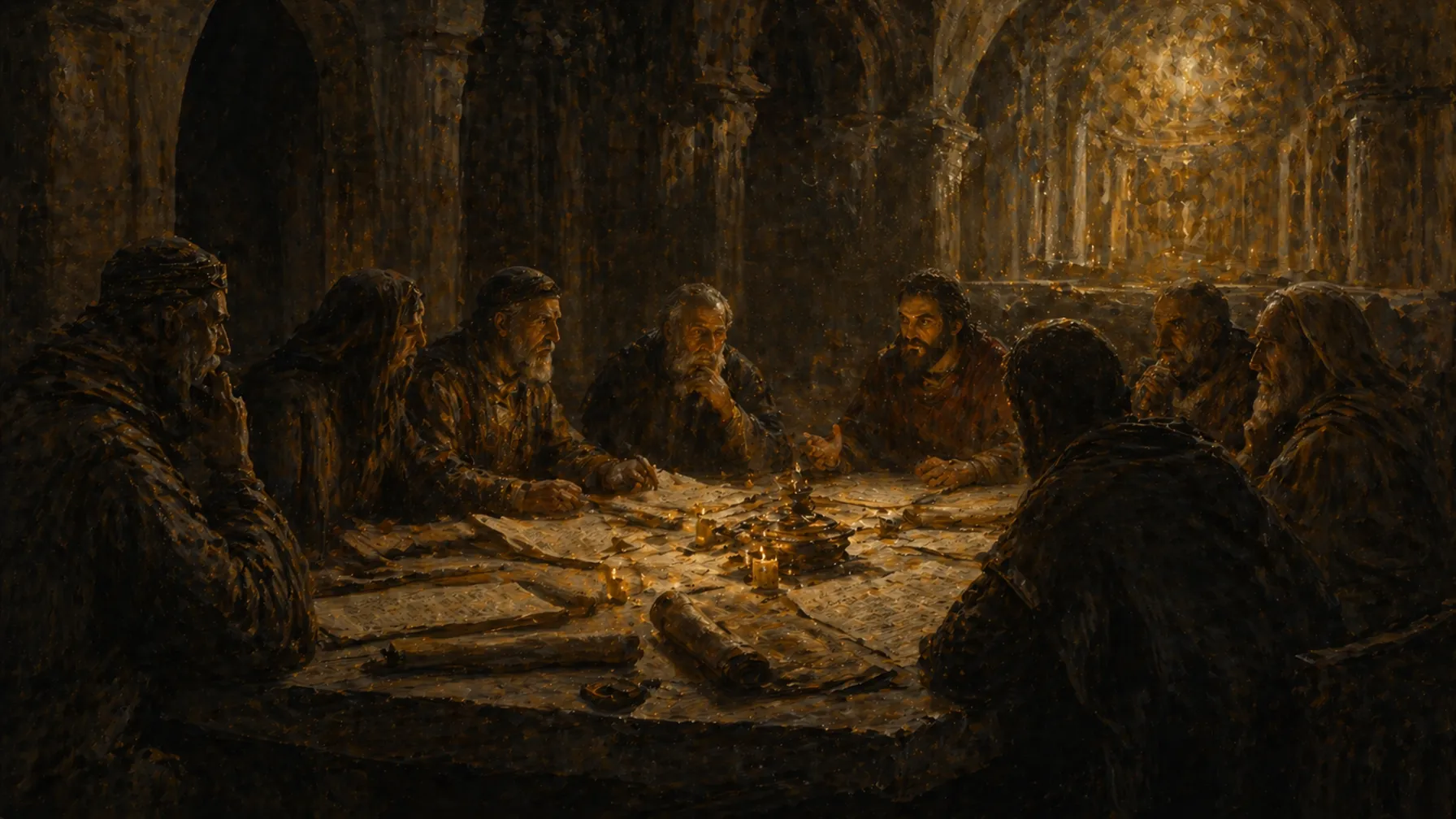
No council invented the canon. Churches were already reading and copying the same books long before any list was formalised, and later councils recognised what was already in use rather than deciding it. Nicaea in 325 did not discuss the canon at all. The criteria were apostolic origin, widespread use, and consistency with existing teaching.
One of the most persistent myths in popular Christian culture goes like this: Constantine called the Council of Nicaea in 325 AD, bishops voted on which books would be in the Bible, losers were burned, and the winners shaped the Christianity we have today. The myth is vivid, it has fueled bestselling novels, and it is almost entirely false. The Council of Nicaea addressed the deity of Christ. It did not debate Scripture. The books the church read as Scripture were already circulating, already authoritative, and already recognized across scattered congregations long before Constantine called any council.
Did a council vote on which books are in the Bible?
The most important distinction in canon history is between recognition and invention. Church councils did not grant the biblical books their authority. They described what churches were already treating as authoritative. Paul makes the underlying logic clear: "All Scripture is breathed out by God" (2 Timothy 3:16). The authority is in the origin, not in the council's stamp of approval. A council affirming that Romans is Scripture is like a scientist confirming that the sun exists. The recognition is useful. It is not what makes the thing real.
This matters pastorally because the conspiracy-theory version implies that the canon is a human product, revisable in principle by a later human vote. The historical version shows something different: the church, spread across multiple continents and centuries, arrived at the same list organically, without a central authority coordinating them. That convergence is harder to explain than a vote.
How was the Old Testament canon settled?
Jesus inherited a canon and treated it as settled. In Matthew 22:29 he rebuked the Sadducees with "You are wrong, because you know neither the Scriptures nor the power of God." In Luke 24:44 he told his disciples that everything written about him "in the Law of Moses and the Prophets and the Psalms must be fulfilled," naming the standard Jewish tripartite division of the Hebrew Bible. Jesus quoted from all three sections throughout his ministry without ever signaling that the boundaries were in question. The Old Testament canon, in its Hebrew form, was functionally settled by the first century.
The Apocrypha complicates this for some. Jerome, who produced the Latin Vulgate in the late fourth and early fifth century, translated the deuterocanonical books that appear in the Greek Septuagint but noted in his prefaces that they lay outside the Hebrew canon. Catholic tradition, formalized at the Council of Trent in 1546, affirms these books as canonical. Protestant tradition, following the Hebrew boundary, does not. Neither position is a conspiracy. Both recognize the books' historical and devotional value; the question is one of scope and authority, and Christians have debated it carefully for centuries.
How did the New Testament canon take shape?
Paul's letters were treated as authoritative within his own lifetime. Peter, writing near the end of his life, groups them with "the other Scriptures" (2 Peter 3:15-16), a phrase that would have meant something clear to readers who had been raised on the Torah and the Prophets. Churches copied and circulated these letters to one another. Colossians 4:16 shows Paul himself directing an exchange between congregations: "When this letter has been read among you, have it also read in the church of the Laodiceans." The transmission was deliberate, not accidental.
By around 170 AD, a document discovered in Milan in 1740 and now called the Muratorian Fragment listed the books already widely accepted in Rome. It names 22 of the eventual 27 New Testament books. Hebrews, James, 1-2 Peter, and 3 John are absent or disputed at this stage. The list is not a papal decree. It is a description of what a large urban church was already using. Other church centers had similar, overlapping lists. The process was messy precisely because it was organic.
What criteria were used to recognise Scripture?
Three questions guided early church discernment when books were disputed. First, apostolic connection: was the book written by an apostle, or by someone with close apostolic authority? Hebrews is anonymous, which created uncertainty; eventually its theology and its use in apostolic churches carried it. Second, widespread acceptance: was the book being read consistently across geographically separate churches, or only in one region? Revelation was debated in the East far longer than in the West. Third, theological coherence: did the book cohere with what the churches had already received as Scripture? Books that contradicted the apostolic deposit did not survive scrutiny regardless of what they claimed about themselves.
Who first listed the 27 New Testament books?
The first document to list exactly the 27 books of the New Testament we now have is Athanasius's 39th Festal Letter, written in 367 AD. He sent these annual Easter letters from Alexandria to churches in Egypt, and this one included a careful enumeration of which books belong to the canon and which are good for reading but not authoritative in the same way. Athanasius was not legislating. He was confirming what had developed over three centuries of church practice. The same 27 books appear in the canons of the Councils of Hippo (393 AD) and Carthage (397 AD), councils that ratified what Athanasius had described.
Why is the messy history reassuring?
The process was slow, distributed, and sometimes contentious. James was questioned. Revelation was debated. 2 Peter had skeptics. The fact that disputed books were genuinely disputed, not rubber-stamped, tells you that the church was applying real criteria and not simply accepting everything in sight. And then the fact that scattered communities across the Roman Empire and beyond converged on nearly identical lists, without email and without a single central authority, is remarkable. The convergence is not what you would expect from a human political process. It is what you might expect if one mind was working through many hands.
The Chicago Statement on Biblical Inerrancy (1978) puts it cleanly in Article II: "We affirm that the Scriptures are the supreme written norm by which God binds the conscience, and that the authority of the Church is subordinate to that of Scripture." The church did not create its own rule. It recognized the rule it had been given. That theological conviction is also, as it happens, the best description of what historically occurred.
This week, if someone in your group raises the Nicaea myth, you can answer it with one question: if Constantine "chose" the books in 325, why is the Muratorian Fragment from 170 already listing most of them?
Sources
- Athanasius, Festal Letter 39 (367 AD) · The earliest surviving list of the 27 New Testament books
- The Muratorian Fragment (c. 170 AD) · An early canon list predating any council
Terms in this article
Every passage each one appears in, with the definition attributed to its source.
Keep reading
Reading the Bible
Reading the Gospels
The Gospels are portraits, not transcripts. Why the church kept four accounts, how to read synoptic parallels, and where John works differently.
Reading the Bible
Reading Apocalyptic
Apocalyptic means unveiling, not prediction. How to trace Revelation's symbols back to Daniel, and why reading it flatly backfires.
Reading the Bible
Gospel Equilibrium
Lose the cross at the center and the gospel tilts: moralism on one side, sentimentality on the other. Why the balance has to be relearned.


