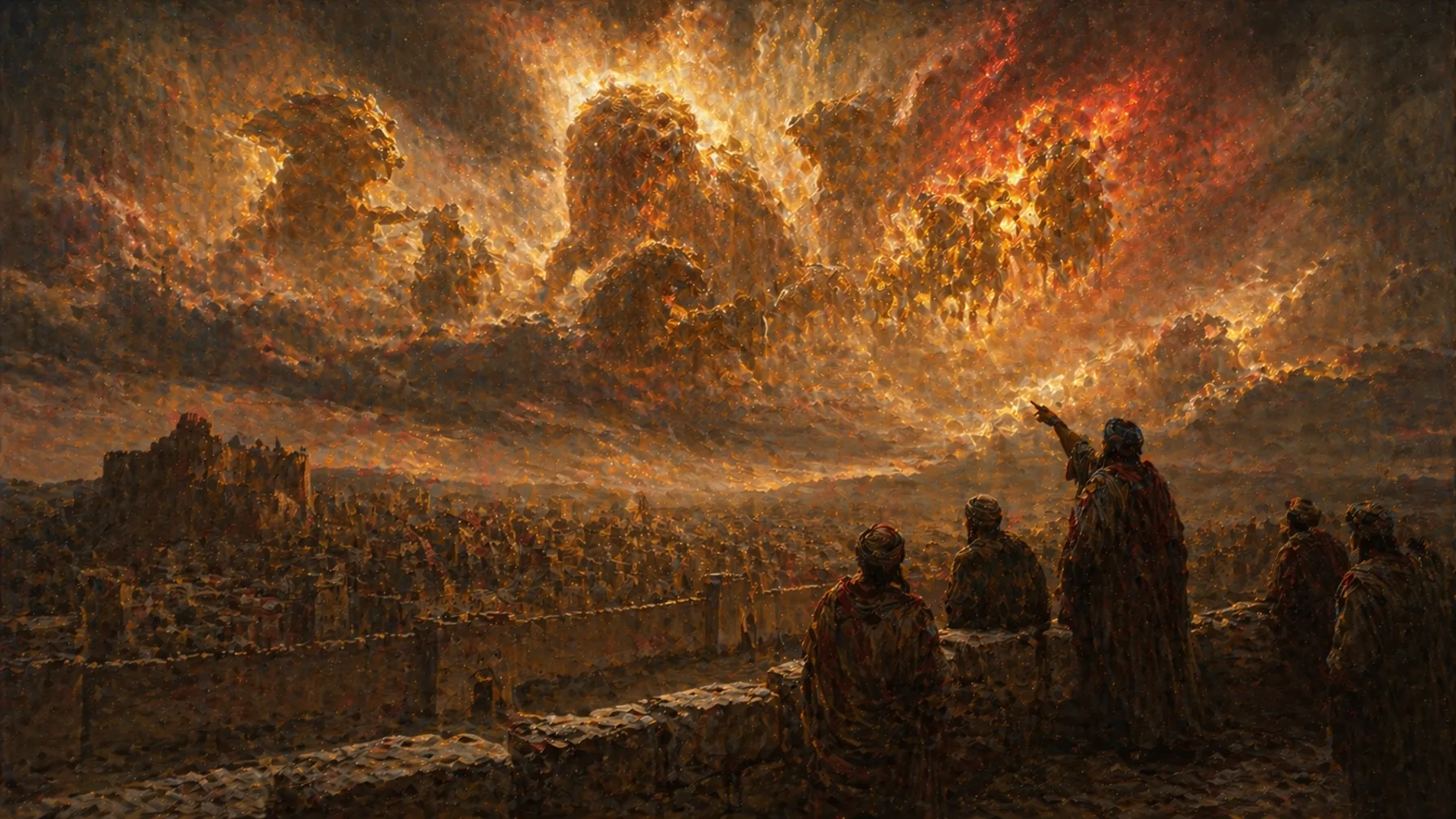
Apokalypsis means unveiling, and Revelation was written to sustain suffering churches rather than to satisfy curiosity about dates. Its symbols almost always have an Old Testament source: the beast of Revelation 13 should be read through Daniel 7 before anyone reaches for a modern figure. Flat literal reading of apocalyptic produces the opposite of careful interpretation.
A church in Smyrna is being economically strangled. Its members cannot trade in the guilds without burning incense to Caesar. Some have already been arrested. They receive a letter. The opening line promises a blessing on everyone who hears it read aloud (Revelation 1:3). What follows is not a timetable of events two thousand years away. It is a cosmic vision written to show suffering people what is actually true about the world they are living in right now. Read it as prophecy journalism and you will miss everything it was sent to do.
What "apocalyptic" actually means
The word comes from the Greek apokalypsis, meaning unveiling or disclosure. Revelation 1:1 opens with it: "The revelation of Jesus Christ, which God gave him to show to his servants the things that must soon take place." An unveiling, not a forecast. Apocalyptic literature was a known genre in the first century. Jewish readers had Daniel, 1 Enoch, 4 Ezra. They knew the conventions: symbolic beasts, heavenly courts, angels interpreting visions, numbers carrying coded meaning. None of this was strange to the seven churches. It would have been as recognizable to them as a documentary format is to us.
What makes this genre work is Old Testament imagery. The visions are not invented from scratch. Isaiah sees the Lord on a throne, with seraphim crying "Holy, holy, holy" (Isaiah 6:1-3). Ezekiel sees four living creatures, wheels within wheels, a vault of ice overhead, and above it a sapphire throne (Ezekiel 1:4-26). John's opening vision in Revelation 1 is built from those same materials. The imagery is not a code to crack. It is a tradition to inhabit.
Tracing the symbols back to their source
The clearest demonstration of this method is the beast in Revelation 13. Most readers hit verse 1 and start asking which political figure it refers to. Before you do that, go back to Daniel 7. Daniel sees four beasts rise from the sea: one like a lion, one like a bear, one like a leopard, and a fourth so terrifying it has no animal equivalent. These represent successive world empires pressing down on the people of God. Now read Revelation 13:2 carefully: "the beast I saw was like a leopard; its feet were like a bear's, and its mouth was like a lion's mouth." John has collapsed Daniel's four beasts into one. He is saying that every empire that has ever crushed the people of God is now concentrated in what Rome is doing to these churches. The symbol is not a riddle about the future. It is a theological statement about the present.
Then comes 666. Revelation 13:18 says, "let the one who has understanding calculate the number of the beast, for it is the number of a man, and his number is 666." The text itself signals a code. Gematria, the practice of assigning numerical values to letters, was common in both Hebrew and Greek. "Nero Caesar" spelled out in Hebrew letters sums to 666. That name would have landed with recognition in any church that had watched Christians burned in his gardens. Whether the calculation points to Nero specifically or to the type of ruler he represented, the first-century meaning was not obscure. This beast wears a crown that falls short of the divine number seven. It is powerful. It is not ultimate. The symbol was written to be felt by people under that power, not decoded by people in a future they could not imagine.
The son of man who stands above every empire
Daniel 7:13-14 is the other load-bearing text. Daniel sees "one like a son of man" coming with the clouds of heaven before the Ancient of Days. To him is given "dominion and glory and a kingdom, that all peoples, nations, and languages should serve him." This is the counter-vision to the beasts rising from the sea. Empires rise. They terrify. They fall. The son of man receives the kingdom that none of them can hold. John builds Revelation on this structure. The churches at Pergamum and Smyrna are not waiting for history to vindicate them at some unknown future date. They are hearing, right now, that the one who holds "the keys of Death and Hades" (Revelation 1:18) has already won the authority those emperors are performing.
Four frameworks, one question upstream of all of them
Serious interpreters organize their reading of Revelation around four frameworks. Preterists argue the visions were largely fulfilled in the first century. Historicists map the book across the whole sweep of church history. Futurists hold that most visions describe events still to come. Idealists read the imagery as timeless spiritual realities. Each framework has careful scholars behind it, and this article takes no position on which is right.
What matters for your group is the question upstream of all four. Are you reading the symbols as symbols, or as journalism? Every framework does better work when it starts with genre awareness. The preterist asks what Rome looked like through this imagery. The futurist asks what a coming empire will look like through it. Both ask better questions than the reader who skips the symbol entirely.
The pastoral purpose behind the visions
John did not write to satisfy curiosity about the future. He wrote to sustain people who were suffering in the present. The blessing in 1:3 is for those who hear and keep what is written, not for those who calculate what is predicted. When John pulls back the curtain on Rome's power, he is not offering political analysis. He is saying, look at what stands behind that throne. Look at the Lamb who was slain and is now seated (Revelation 5:6). Your suffering is not the end of the story because the one who holds your story has already absorbed the worst the beast can do.
Revelation 21:1-4 is where that pastoral logic lands. "He will wipe away every tear from their eyes, and death shall be no more, neither shall there be mourning, nor crying, nor pain anymore, for the former things have passed away." Not a geographic prediction. Not a dispensational chart. It is the answer the Smyrna church needed when faithfulness was costing them everything. The genre exists to make that answer felt, not just understood.
Why "reading it literally" backfires
The instinct to read Revelation "literally" comes from a good impulse, which is to take the Bible seriously. But flat reading applied to apocalyptic produces the opposite of serious interpretation. When John says the beast has seven heads and ten horns (Revelation 13:1), a surface reading looks for a creature or a confederation. A genre-aware reading asks what seven and ten signify in the symbolic vocabulary John is using, then traces those numbers through Daniel and the Old Testament to find the answer. That is more rigorous, not less.
Pastoral harm follows when the genre is misread. When Revelation becomes a newspaper for the future, it stops doing what it was written to do. A community reading it as a roadmap tends to focus on sequence and timing. One reading it as a vision for suffering people tends to find courage and reorientation. The first-century church at Pergamum, holding this letter under Domitian, was not being trained to predict. It was being trained to endure. For the broader genre framework underneath this, see Reading by Genre. For how the prophetic tradition that feeds this imagery works, see Prophets as Covenant Voice.
Before your group reads any passage in Revelation this week, look up every Old Testament text John is quoting or echoing in the margin notes of a study Bible, and read those texts first.
Terms in this article
Every passage each one appears in, with the definition attributed to its source.
Keep reading
Reading the Bible
Are Proverbs Promises? Wisdom and Its Edges
A proverb is a reliable pattern, not a guarantee. How Proverbs, Job and Ecclesiastes argue with each other on purpose, and how to teach that faithfully.
Reading the Bible
The Gospel Through the Canon
Jesus walked the Emmaus road and read himself out of Moses and the Prophets. How the promise narrows across the canon, and where the method goes wrong.
Reading the Bible
Reading the Gospels
The Gospels are portraits, not transcripts. Why the church kept four accounts, how to read synoptic parallels, and where John works differently.


