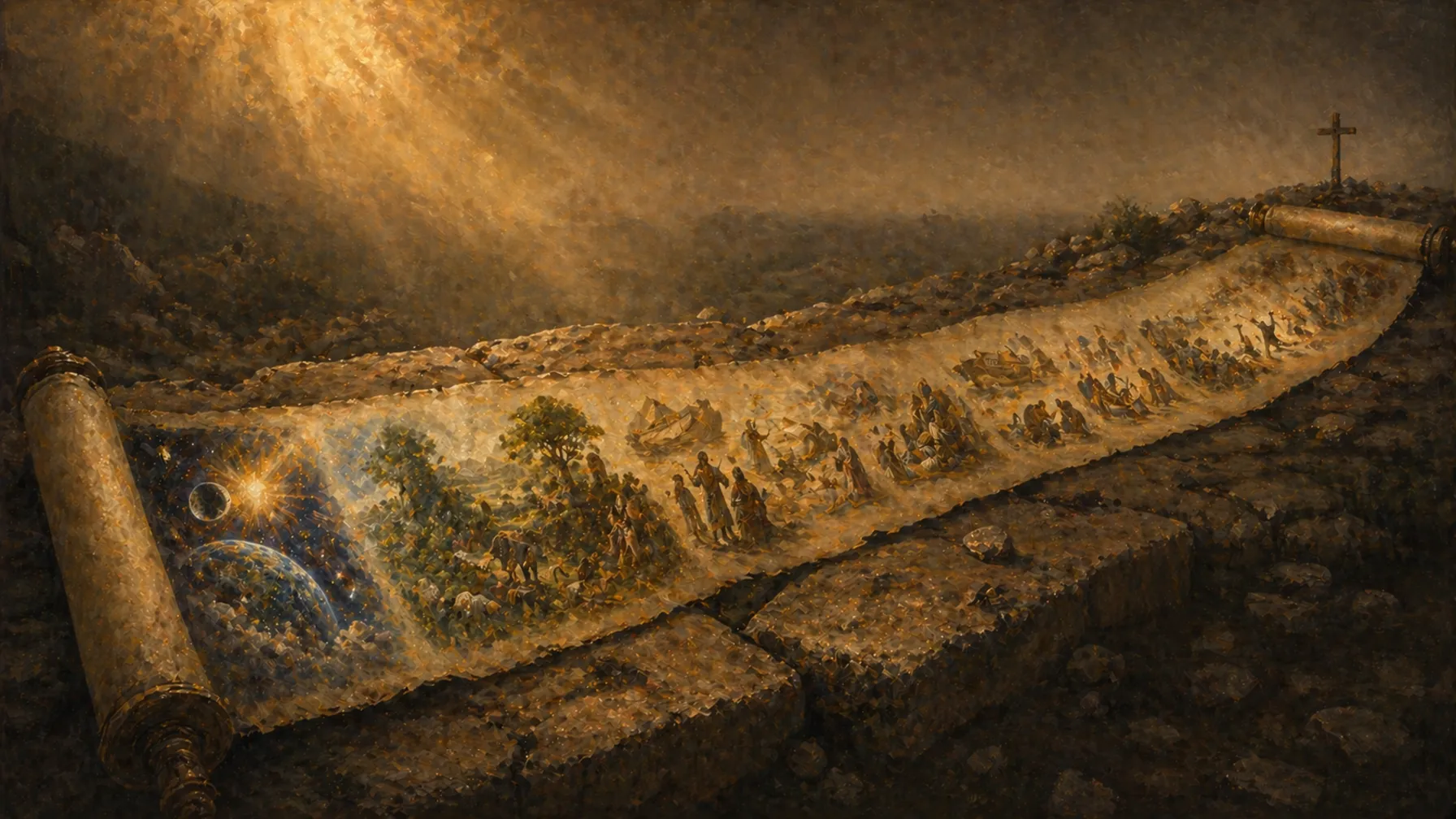
Christ read the whole Old Testament as being about himself on the Emmaus road, and Paul says he died and rose according to the Scriptures. The promise narrows steadily from Genesis 3 through Abraham, and the prophets function as covenant enforcers who name the problem before announcing what God will do. The method goes wrong when it becomes finding a hidden Jesus in every verse.
Two disciples are walking away from Jerusalem, three days after the crucifixion, convinced the story is over. A stranger joins them on the road to Emmaus and asks what they are talking about. They unload everything: the arrest, the trial, the death, the empty tomb. Then the stranger speaks. "Beginning with Moses and all the Prophets, he interpreted to them in all the Scriptures the things concerning himself" (Luke 24:27, ESV). That road was a seminary. The curriculum was every book they had ever owned. The teacher was the subject of every one of them.
One story, not a collection
Paul states the method with precision in 1 Corinthians 15:3-4: Christ died for our sins "according to the Scriptures," was buried, and rose on the third day "according to the Scriptures." He does not cite a single text. He refers to the whole pattern. The death and resurrection of Jesus were not new events that the OT happened to predict. They were the events the OT was building toward. The Scriptures were always a story in need of an ending, and Paul is saying the ending has arrived.
The four-part arc that holds the canon together is creation, fall, redemption, and consummation. None of those words appears in that order in a single biblical passage. But the arc is legible across every genre. Genesis 1 and 2 describe a world declared good, filled with life, ordered around the presence of God. Genesis 3 is the fracture. The rest of the Bible is the long story of what God does about the fracture, and Revelation 21 and 22 bring it to its conclusion: a new heaven and a new earth, the dwelling of God with his people, no more death, no more mourning (Revelation 21:3-4).
The narrowing of the promise
After Genesis 3, God does not announce a general amnesty. He calls one man. To Abraham he says: "in you all the families of the earth shall be blessed" (Genesis 12:3). This is the hinge on which the rest of the OT swings. God narrows his focus to one family in order to reach every family. From Abraham to Isaac, Isaac to Jacob, Jacob's twelve sons to one tribe, Judah, and from Judah to one king, David, to whom God promises: "Your house and your kingdom shall be made sure forever before me. Your throne shall be established forever" (2 Samuel 7:16).
Each step of that narrowing is a step toward the one in whom all the promises converge. Paul reads it this way without apology. The promise to Abraham was made to his "offspring" singular, not plural, "referring to one who is Christ" (Galatians 3:16). The covenant structure is not a series of separate agreements. It is one escalating commitment reaching its target.
The prophets and the problem they name
The prophets are not primarily predictors. They are covenant enforcers. Their job was to hold Israel accountable to Sinai and to announce what God would do when Israel failed. Isaiah 53 does both. The servant bears the iniquities of his people: "he was wounded for our transgressions; he was crushed for our iniquities; upon him was the chastisement that brought us peace, and with his stripes we are healed" (Isaiah 53:5). Written six centuries before the cross, this is not a general statement about suffering. It is substitution still waiting for a face.
Jeremiah diagnoses the deeper problem the law exposed. Israel kept breaking the Mosaic covenant not because the law was wrong but because the heart was unchanged. So Jeremiah announces something God will do unilaterally: "I will put my law within them, and I will write it on their hearts" (Jeremiah 31:33). That new covenant is what Jesus ratifies at the last supper: "This cup that is poured out for you is the new covenant in my blood" (Luke 22:20).
Reading with the grain of the text
A word of caution matters here. Christ-centered reading is not the same as finding a hidden Jesus in every verse. The Song of Solomon is not an allegory of the soul's union with Christ dressed in romantic language. Proverbs is not secretly about the cross. The discipline is to read with the grain of the text, asking where each book fits in the single story, not to import a foreign meaning against the text's own intent. Wisdom literature celebrates the goodness of God's ordered world, which is itself a fruit of creation theology and a window into the character of the Creator.
Where the connection to Christ is genuine, the text usually announces it or the NT authors draw it explicitly. Hebrews 10:1 says the law had "a shadow of the good things to come instead of the true form of these realities." The sacrificial system was designed to be provisional. The temple pointed beyond itself. The Passover lamb was not arbitrarily chosen; Paul names the logic: "Christ, our Passover lamb, has been sacrificed" (1 Corinthians 5:7). These connections come from the structure God built into history, not from a reader's creativity.
The Spirit, the church, and the not-yet
The story does not end with the resurrection. Acts begins where Luke ends: the risen Christ sends his disciples out, and at Pentecost the Spirit falls, fulfilling what Joel had announced: "I will pour out my Spirit on all flesh" (Joel 2:28, cited in Acts 2:17). The church is not an organizational footnote to the gospel. It is the community formed by the Spirit to announce what God has done in Christ while the consummation is still coming.
Revelation 21 brings the whole arc to rest. The new Jerusalem descends. The tree of life reappears. God's dwelling is with his people, and they will reign forever (Revelation 22:5). The ending answers the beginning, and everything in between is the story of how God got there.
Why this changes how you teach any passage
Knowing the arc does not make every passage mean the same thing. It gives every passage an address. A text from Leviticus is part of the covenant structure that Paul will say Christ fulfills. A psalm of lament is the voice of God's people crying out from within the long story, trusting that the story is not over. A parable in Luke is Jesus announcing, in the hearing of first-century Israel, that the kingdom long promised is arriving in him.
The two disciples on the road did not lack information. They had all the texts. What they lacked was the key. Jesus gave it to them by showing how every part of Scripture was building toward what had just happened. Their response was immediate: "Did not our hearts burn within us while he talked to us on the road, while he opened to us the Scriptures?" (Luke 24:32). That is the kind of teaching the whole canon makes possible.
Before your group studies its next passage, spend five minutes placing it on the arc: creation, fall, redemption, consummation, and ask which part of God's one story this text is carrying.
Terms in this article
Every passage each one appears in, with the definition attributed to its source.
Keep reading
Reading the Bible
The Gospel Announced
Euangelion was the word for a herald's battle report. What Paul handed on as of first importance, and why the burial is in the formula.
Reading the Bible
Reading the Gospels
The Gospels are portraits, not transcripts. Why the church kept four accounts, how to read synoptic parallels, and where John works differently.
Reading the Bible
Reading Apocalyptic
Apocalyptic means unveiling, not prediction. How to trace Revelation's symbols back to Daniel, and why reading it flatly backfires.


