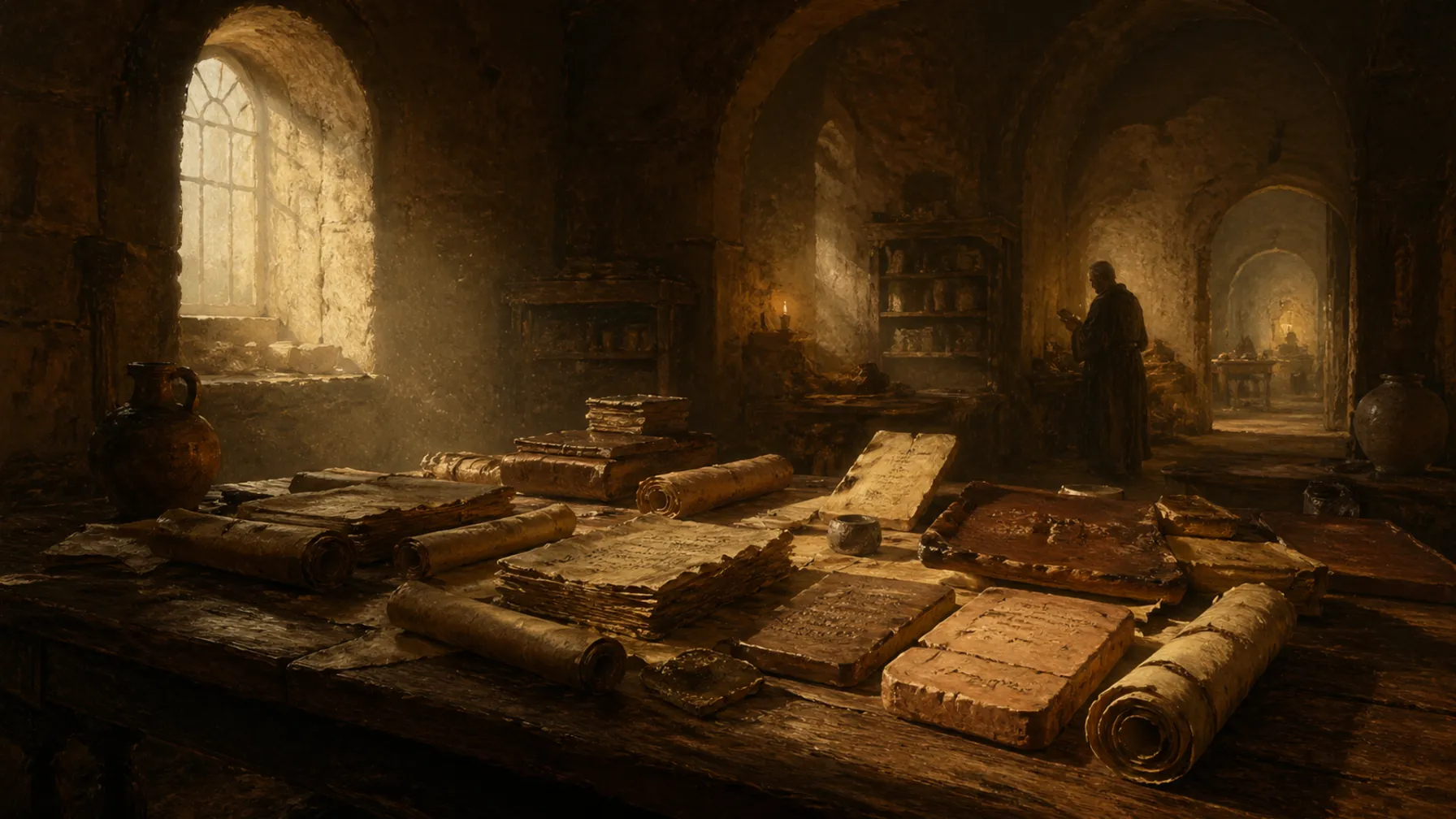
The Bible contains at least seven kinds of literature and each has its own rules. Narrative records what happened without always endorsing it, which Judges makes plain. Hebrew poetry uses hyperbole as native grammar. Wisdom speaks in probabilities rather than guarantees. Prophecy is more often covenant lawsuit than prediction, and the Gospels are shaped portraits rather than neutral transcripts.
Picture someone reading a legal contract the way they'd read a love letter. They slow down at every metaphor, feel the warmth in the boilerplate, and take "the party of the first part" as an intimate address. We find that absurd. We do something very similar when we read the book of Job as a financial promise, or Revelation as a newspaper forecast, or a Hebrew lament as a liturgy for Sunday morning worship. Genre shapes meaning. Miss the genre and you miss what the text is actually doing.
The single biggest lever
The Bible is one book with one God-breathed message, and it contains at least seven distinct kinds of literature: narrative, poetry, wisdom, prophecy, gospel, epistle, and apocalyptic. Each has its own conventions, its own way of making claims, and its own way of going wrong when read naively. Before you ask what a passage means, ask what kind of writing it is. That question is the single biggest hermeneutical lever you have. It shapes everything downstream: how you weigh specific verses, how you identify what is descriptive versus prescriptive, and how you move from the ancient text to Tuesday night's group discussion.
Narrative: reported, not prescribed
Biblical narrative records what happened. It does not always endorse it. Judges is the clearest proof. "Everyone did what was right in his own eyes" (Judges 21:25), and the text shows us the carnage that follows without a single editorial verdict. When we read that Abraham lied about Sarah (Genesis 12:13) or that Jacob deceived his father (Genesis 27:19), the author isn't handing us a playbook. He's tracing the mess of real lives inside a faithful God's unfolding purpose. Read narrative as prescription and you end up imitating Samson's vengeance or defending polygamy from the patriarchs.
Poetry: hyperbole is the point
Hebrew poetry uses parallelism, imagery, and hyperbole as its native grammar. Psalm 22:14 says, "I am poured out like water, and all my bones are out of joint." David isn't describing a medical condition. He's voicing total disintegration, the felt reality of abandonment. When Psalm 137:9 blesses the one who dashes infants against rocks, that's a raw cry of grief from Babylonian exile, not a divine command for warfare. Read it flat and you produce either a pastoral crisis or a theological scandal. Read it as lament and you find God honoring the full weight of human suffering with His presence.
Wisdom: observation, not guarantee
Proverbs speaks in probabilities, not promises. "Train up a child in the way he should go; even when he is old he will not depart from it" (Proverbs 22:6) describes what is generally true across human experience. It's a proverb, not a covenant. The book of Job is written specifically to correct the reader who turns Proverbs into an iron law. Job's friends do exactly that. They weaponize wisdom against a suffering man and are rebuked by God for it (Job 42:7). Wisdom literature trains discernment. It does not issue unconditional guarantees.
Prophecy: covenant lawsuit, not just prediction
We tend to read the prophets as predictors. They're more often prosecutors. Isaiah, Jeremiah, and Amos are prosecuting Israel for covenant unfaithfulness before a divine court. The classic form is the covenant lawsuit, called a rib in Hebrew, in which God calls creation as witness and lays out the charges (Isaiah 1:2). Read prophecy as pure prediction and you skip the actual word God was delivering to actual people in actual crisis. Some oracles do point forward to Christ, and that forward-pointing is real. But the first question is always: what was God saying to this people, in this moment, about this covenant?
Gospel: portrait, not bare chronicle
Each of the four Gospels is a theologically shaped portrait of Jesus, not a neutral transcript. Matthew presents Jesus as the new Moses, arranging five great discourses to echo the Pentateuch. Mark moves at speed, with "immediately" appearing more than forty times, stressing the urgent authority of the Son of God in action. When Matthew and Luke order events differently, neither is wrong. They're making different theological points. Harmonizing every difference into a flat timeline misses what the Spirit was doing through each author.
Epistle: occasional letter, not timeless code
Paul, Peter, and John wrote letters to specific churches facing specific problems. First Corinthians exists because Corinth had factions, lawsuits, and a chaotic worship service. When Paul addresses head coverings in 1 Corinthians 11, he's solving a particular problem in a particular culture. That doesn't mean we discard the text. It means we ask what principle is being applied here, then ask how that principle applies in our own context. Read every epistle as if you only have one side of a phone call. The other side is the community crisis you need to reconstruct to understand the answer.
Apocalyptic: symbol, not cipher
Apocalyptic literature, Daniel and Revelation especially, uses symbolic visions to reveal what is true at a cosmic level about present reality. John writes to seven churches living under Roman imperial pressure. The beast of Revelation 13 isn't a coded prediction for a distant century. It's a symbol for the crushing power of empire those seven churches felt every single day. Reading apocalyptic as a cipher for future newspaper headlines misses the pastoral nerve of the genre. These visions were written to sustain people who were suffering now, not to satisfy speculation about later.
Put it to work
Genre awareness doesn't make interpretation complicated. It makes it honest. God chose to speak in poetry and narrative and legal argument and visionary symbol because each of those forms carries truth in a way plain propositions cannot. As Peter put it, "men spoke from God as they were carried along by the Holy Spirit" (2 Peter 1:21), through their genres, their personalities, their moments. Respecting the genre is respecting that choice. For more on how historical and cultural setting shapes meaning alongside genre, see Why Context Matters and Contextual Study.
Before you teach any passage this week, write the genre at the top of your notes and ask one question: what does this kind of writing expect me to do with it?
Terms in this article
Every passage each one appears in, with the definition attributed to its source.
Keep reading
Reading the Bible
Are Proverbs Promises? Wisdom and Its Edges
A proverb is a reliable pattern, not a guarantee. How Proverbs, Job and Ecclesiastes argue with each other on purpose, and how to teach that faithfully.
Reading the Bible
The New Testament Arc
Gospels, Acts, Epistles, Revelation. Four movements that need each other, and what you lose reading any one of them on its own.

Reading the Bible
The Gospel Through the Canon
Jesus walked the Emmaus road and read himself out of Moses and the Prophets. How the promise narrows across the canon, and where the method goes wrong.


