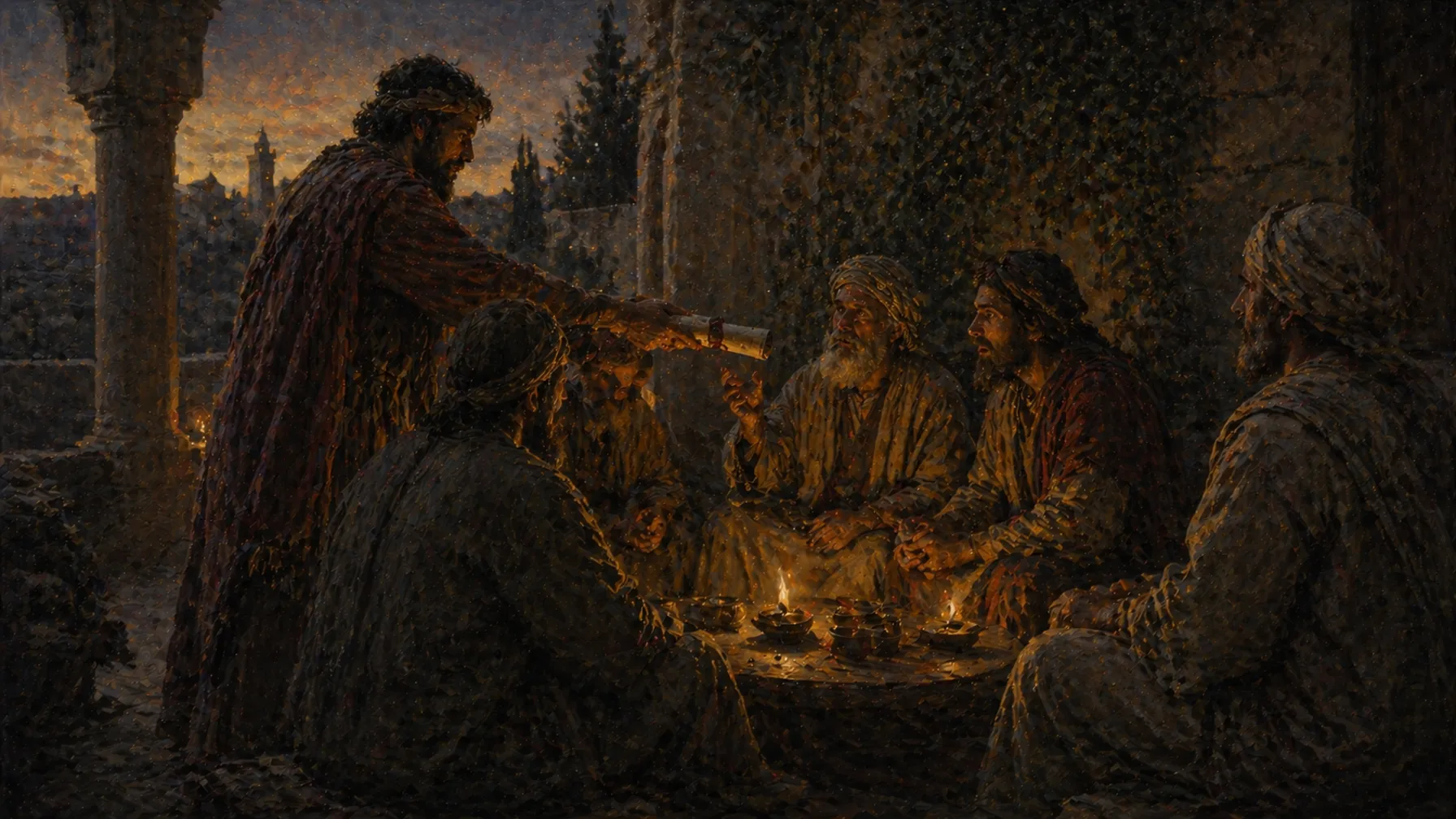
The New Testament letters are real correspondence, not essays, so the first question is what problem each was written to solve. Philippians 4:13 reads very differently once you notice Paul is describing contentment in scarcity rather than achievement. Paul's commands also follow a pattern: he establishes what God has done before he says what to do.
Walk into almost any gym locker room in America and you'll find Philippians 4:13 on the wall. "I can do all things through him who strengthens me." Athletes tape it to mirrors. Graduates put it on cards. Parents frame it for nurseries. The verse is true. But when you read what Paul wrote in the four verses before it, you find something stranger and harder than a motivational slogan. Paul was in prison when he wrote this. He was not talking about winning. He was talking about contentment. "I have learned, in whatever situation I am, to be content," he says in Philippians 4:11. The "all things" in verse 13 is not a promise about achievement. It is a confession about survival. I can bear hunger, abundance, plenty, and need, because Christ is the one holding me. Context does not water down the verse. It makes it heavier and more glorious.
That example is the case for everything that follows. The epistles reward careful reading because they were written to specific people facing specific crises, and most of what Paul argues only makes sense once you know what he is answering.
Letters, not treatises
The New Testament epistles are real letters. Not essays dressed up as correspondence. Real letters, with greetings, travel plans, personal names, pastoral emergencies, and the kind of mid-sentence pivots you get when someone is writing to people they know well. The closing chapter of Romans reads like a guest list: Phoebe, Prisca, Aquila, Epaenetus, Andronicus, Junia. Paul is not padding. He is finishing a letter to a church he has never visited, carefully naming every connection he has there to build trust before he arrives. Philemon is four paragraphs about one runaway slave. These are not systematic theologies. They are occasional documents, written to address specific occasions.
This matters because we tend to read the epistles like a reference manual, opening to any page and reading one sentence in isolation. A letter is an argument from first word to last. Paul builds. He qualifies. He answers objections. He circles back. When you pick up a single verse without the surrounding argument, you are reading the punchline of a joke you never heard the setup for. The genre work covered in Reading by Genre applies directly here. Epistles are a distinct form with their own rules, and those rules shape what every individual verse can mean.
Hear their question first
Start with one question: what problem was this letter written to solve? The answer reshapes how you read almost everything in it.
Take 1 Corinthians 8. Paul spends three chapters on food sacrificed to idols. That sounds like an obscure ancient problem until you picture Corinth: a city full of temples where meat was slaughtered in religious ceremonies and then sold cheaply in the market. For a new Gentile believer, every shared meal was potentially loaded with theological freight. Was eating this meat an act of worship to another god? Could a "strong" Christian eat while a "weak" one stumbled into idolatry? Paul's answer in 1 Corinthians 8:9 is not primarily about dietary rules: "Take care that this right of yours does not somehow become a stumbling block to the weak." The whole argument, freedom subordinated to love, only lands with force when you feel the weight of that Corinthian dinner table.
Galatians is even more telling. Paul opens with fire: "I am astonished that you are so quickly deserting him who called you in the grace of Christ and are turning to a different gospel" (Galatians 1:6). He skips the greeting. That absence is a signal. Teachers had arrived in Galatia insisting that Gentile converts needed circumcision and the Mosaic law to be fully saved. Paul's sharp tone in Galatians 1:8, calling down a curse on anyone who preaches another gospel, is not Paul at his least gracious. It is Paul at his most precise. Once you see what was at stake, that sharpness is not a flaw to soften. It is clarity you can trust.
Indicative, then imperative
There is a structural pattern that runs through Paul's letters that changes how you read every command he gives. Theologians call it the indicative-imperative pattern. Paul always establishes what God has done before he tells you what to do. The fact (indicative) comes before the command (imperative). Identity before behavior.
Ephesians is the cleanest example. Chapters 1 through 3 are almost entirely declarative: you have been chosen, redeemed, sealed, made alive. "For by grace you have been saved through faith. And this is not your own doing; it is the gift of God" (Ephesians 2:8). Then verse 10 pivots: "we are his workmanship, created in Christ Jesus for good works." Chapters 4 through 6 are where the imperatives land. Walk in a manner worthy, put off the old self, be kind to one another, submit to one another. The commands are not the mechanism of salvation. They are the shape of a life that has already been saved. Read the imperatives in Ephesians 4-6 without Ephesians 1-3 behind them and they collapse into a moralism Paul would have rejected outright.
Romans 6 shows the same pattern under pressure. In Romans 5:20, Paul has just said that where sin increased, grace increased all the more. He knows how that sounds. So he voices the objection himself: "Are we to continue in sin that grace may abound?" (Romans 6:1). Then he answers it with an indicative, not a threat: "Do you not know that all of us who have been baptized into Christ Jesus were baptized into his death?" (Romans 6:3). The answer to antinomianism is not a stricter law. It is a deeper grasp of what has already happened to the believer. Paul does not say "you should not sin." He says "you died." The imperative in Romans 6:11, "consider yourselves dead to sin and alive to God," flows out of that prior death and resurrection.
The discipline of the first audience
Good epistolary reading takes a specific discipline. Before you ask what a passage means for your group, you have to ask what it meant for theirs. This is not just historical curiosity. It is a guard against reading our own questions back into Paul's answers. As Why Context Matters argues, a text cannot mean something to us that it could not have meant to its first readers. The original meaning is the anchor, not a constraint.
Application comes after, not instead. Once you hear what Paul was saying to the Galatians about the sufficiency of Christ against the Judaizers, you can ask what our equivalent substitutes for grace look like today. Moral performance. Cultural conformity. Spiritual credentials. The application sharpens because the original diagnosis was precise. Vague application usually traces back to skipped historical work. Know the original problem, and you can find its cousins in your own church without forcing the text beyond its reach.
Go back to Philippians 4:13 with your group this week. Read verses 11 through 13 together, name the prison context, ask what contentment looks like in their hardest current circumstance, and watch the verse grow larger than it was on any locker-room wall.
Terms in this article
Every passage each one appears in, with the definition attributed to its source.
Keep reading

Reading the Bible
The New Testament Arc
Gospels, Acts, Epistles, Revelation. Four movements that need each other, and what you lose reading any one of them on its own.

Reading the Bible
The Gospel Through the Canon
Jesus walked the Emmaus road and read himself out of Moses and the Prophets. How the promise narrows across the canon, and where the method goes wrong.

Reading the Bible
The Gospel Announced
Euangelion was the word for a herald's battle report. What Paul handed on as of first importance, and why the burial is in the formula.


