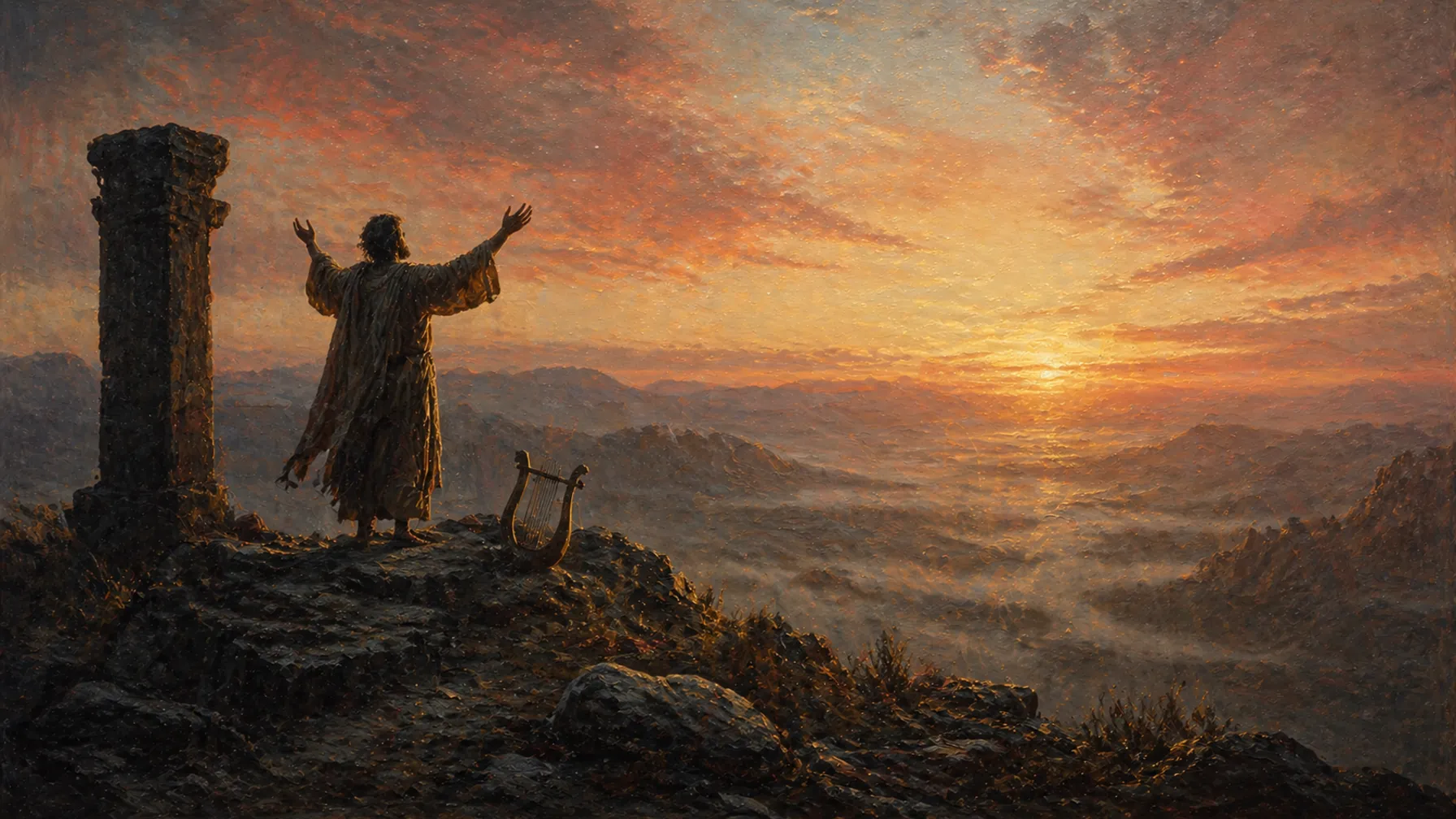
Hebrew poetry does not rhyme, it thinks: parallelism is the primary device, and the second line develops the first rather than repeating it. The Psalter holds the full emotional range, including psalms like 88 that end without resolution, and cherry-picking the celebratory ones teaches people that grief has no home in prayer.
Psalm 88 ends like this: "my companions have become darkness" (Ps 88:18, ESV). No resolution. No sunrise. The psalmist calls out to God from the pit and the poem simply stops. If you've ever brought that psalm to a cell group and watched people go quiet, you know something true happened in the room. The question is whether you knew what to do with it.
How Hebrew poetry works
Most of us were never taught that the Psalms are poems, not just prayers. That distinction matters more than it sounds. Hebrew poetry doesn't rhyme. It thinks. The primary device is parallelism, where a line states something and the next line restates, sharpens, or extends it.
Synonymous parallelism repeats the same idea in different words. Psalm 19:1 is the clearest example: "The heavens declare the glory of God, and the sky above proclaims his handiwork." Both lines say the same thing. The repetition isn't accidental filler. It slows you down and asks you to feel the weight of the claim twice.
Antithetic parallelism sets two lines in contrast. Psalm 37:21-22: "The wicked borrows but does not pay back, but the righteous is generous and gives; for those blessed by the Lord shall inherit the land, but those cursed by him shall be cut off." The contrast is the argument. Wickedness and righteousness aren't similar paths at different speeds. They lead to opposite ends.
Synthetic parallelism builds a thought step by step. Psalm 1:3 pictures the righteous person as a tree planted by streams of water, yielding its fruit in season, with a leaf that does not wither. Each line adds a new dimension to the portrait rather than restating the previous one. When you teach a psalm, ask your group: what is the second line doing to the first? That single question opens the poem's logic.
The full emotional range of the Psalter
The Psalter holds everything. Praise, lament, anger, gratitude, despair, and wonder all have a home here. Cell leaders sometimes cherry-pick the celebratory psalms and avoid the harder ones. That's a pastoral mistake.
Psalm 22 opens with abandonment: "My God, my God, why have you forsaken me?" (Ps 22:1). Jesus quoted this line from the cross. That means lament isn't a failure of faith. It's faith pressed to its limit, still speaking to God.
Psalm 88 goes further. Most lament psalms turn. They remember God's past acts, re-anchor in covenant, and close with praise. This one doesn't turn. It's the only psalm in the Psalter with no resolution, and it matters precisely because it gives language to people whose suffering has no resolution yet. Skipping it in a group setting sends the message that the church can't hold that kind of pain.
Then there's Psalm 137, an imprecatory psalm. "Blessed shall he be who takes your little ones and dashes them against the rock!" (Ps 137:9). Most leaders flinch at that verse. But imprecatory psalms aren't endorsements of revenge. They're the raw, honest cry of people who have watched their children carried away in chains, who bring their rage to God instead of acting on it. That's a more mature response than pretending the rage doesn't exist.
Wisdom poetry shows a different face: Psalm 119 runs 176 verses meditating on the Torah. Doxological praise shows yet another: "Bless the Lord, O my soul, and all that is within me, bless his holy name!" (Ps 103:1). The Psalter holds all of this together. It's a canon within a canon, a full school of prayer.
Poetry as theology, not therapy
Here's the problem worth naming. When we treat the Psalms primarily as emotional resources, we reduce them. "Psalm 23 is for anxiety." "Psalm 46 is for when things feel out of control." This isn't wrong so much as it's thin. The psalms do meet us in emotion, but they're doing more than managing our feelings.
They're forming us theologically. The lament psalms aren't just releasing pressure. They're teaching us that God can be addressed in suffering, that prayer doesn't have to be polished, and that the covenant is the ground we stand on when everything else gives way. Psalm 22 isn't simply about feeling abandoned. It's about the God who does not despise the affliction of the afflicted (Ps 22:24), and it ends in cosmic praise because of it.
When you lead a group through a psalm, the question isn't "how does this make you feel?" It's "what does this psalm teach us about who God is?" Those two questions land in very different places. The first produces a support group. The second produces a worshipping community shaped by the character of God.
This is why genre awareness, which you can build further through Reading by Genre, matters so much here. Poetry works differently than narrative or epistle. It asks to be read slowly, repeated aloud, and felt before it's analyzed. Feeling isn't the goal. The goal is the God the poem points to.
Teaching a psalm well
A few practical anchors for your preparation. First, identify the structure before you identify the message. Where does the poem turn? Most psalms have a pivot, a moment where the speaker's posture changes. In Psalm 13, David asks "How long, O Lord?" four times in the first four verses. Then in verse 5, the posture shifts: "But I have trusted in your steadfast love." That turn is the sermon. It's not a mood change. It's a theological anchor being dropped mid-storm.
Second, read the psalm aloud to your group, twice. Hebrew poetry was composed for the voice and the ear, not silent reading. Something happens when the room hears the words rather than scanning them.
Third, let the hard psalms be hard. Don't soften Psalm 88 or skip Psalm 137. The Psalter was given to the church for formation, not comfort. When you give your group the full range of the Psalter, you give them a bigger God and a more honest faith.
This Tuesday, take Psalm 13 to your group, read it twice aloud, and ask them to find the exact line where the prayer turns and what changes in the speaker's posture at that moment.
Terms in this article
Every passage each one appears in, with the definition attributed to its source.
Keep reading
Reading the Bible
Are Proverbs Promises? Wisdom and Its Edges
A proverb is a reliable pattern, not a guarantee. How Proverbs, Job and Ecclesiastes argue with each other on purpose, and how to teach that faithfully.

Reading the Bible
The New Testament Arc
Gospels, Acts, Epistles, Revelation. Four movements that need each other, and what you lose reading any one of them on its own.

Reading the Bible
The Kingdom of God
Kingdom means reign, not territory. What already and not yet means in practice, and why the church is not the same thing as the kingdom.


