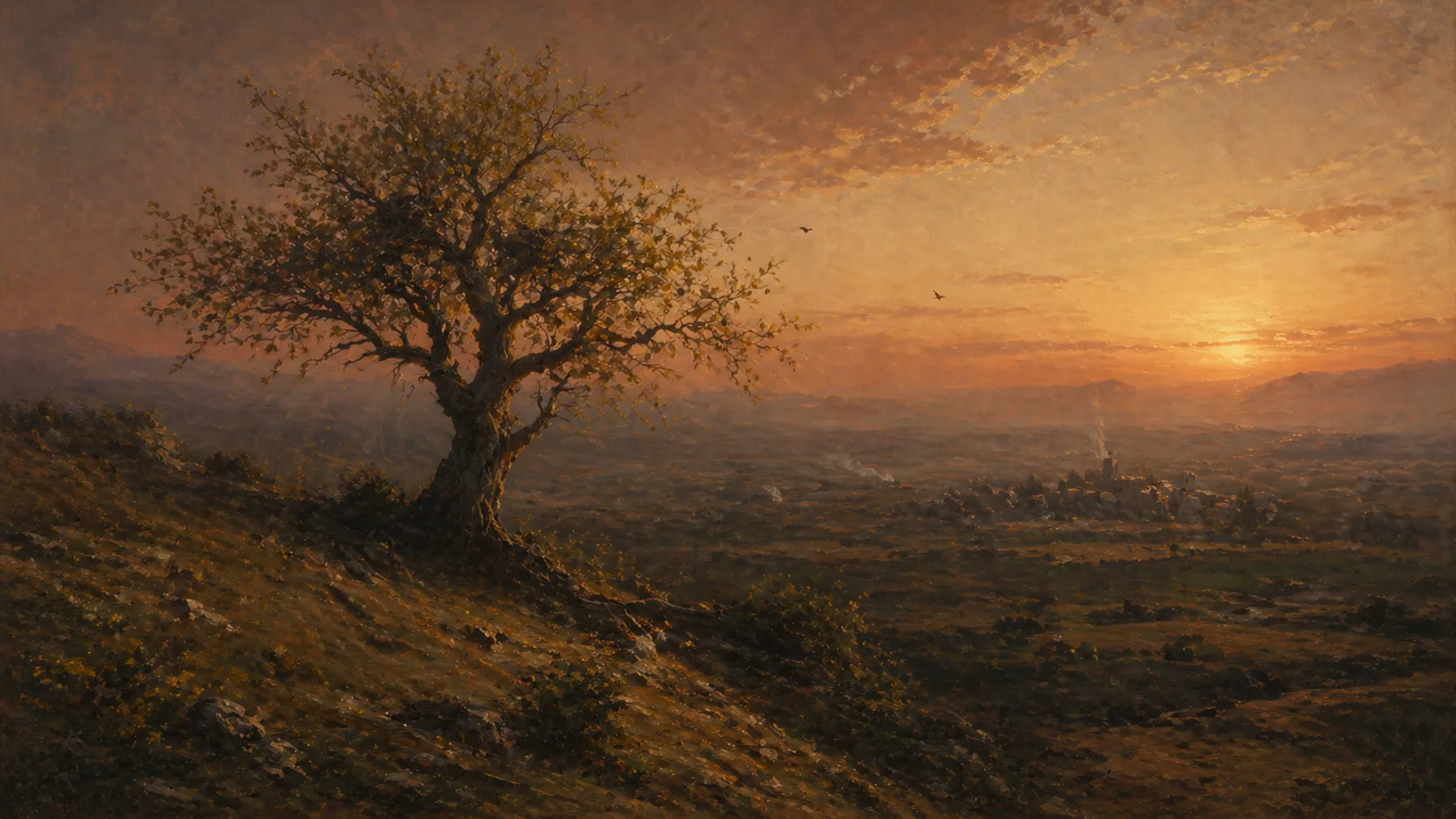
Basileia means reign rather than realm, so the kingdom is God's active rule rather than a place. Jesus announces it as already breaking in, saying that if he casts out demons by the finger of God then the kingdom has come upon them, while still telling disciples to pray for it to come. The church is not the kingdom; it is the community that has submitted to the reign.
When John the Baptist appeared in the wilderness, he had one sentence: "Repent, for the kingdom of heaven is at hand" (Matt 3:2). No preamble, no theology lecture. Just urgency. Something was breaking in that had never broken in before, and the right response was to get out of its way. Then Jesus stepped into Galilee and said almost the same thing: "The time is fulfilled, and the kingdom of God is at hand; repent and believe in the gospel" (Mark 1:14-15). That phrase, kingdom of God, carries the weight of his entire ministry.
What "kingdom" actually means
The Greek basileia and the Hebrew malkuth behind it do not primarily mean territory. They mean reign. Dynamic, active rule. When the Psalms declare "The Lord has established his throne in the heavens, and his kingdom rules over all" (Ps 103:19), the point is not that God owns a plot of land somewhere. The point is that he governs. The kingdom of God is wherever God's will runs without resistance, wherever his authority is acknowledged and obeyed.
This is why Jesus taught his disciples to pray "your kingdom come, your will be done, on earth as it is in heaven" (Matt 6:10). The two lines are parallel. Kingdom come equals will done. Heaven is the place where no one defies God; earth is not yet that place. The prayer is asking for the difference to close.
The Old Testament longing
Israel already knew what it meant to live under God's reign. The covenant at Sinai was not merely a legal arrangement; it was a political one. Yahweh was Israel's king. The prophets, when they spoke of a coming day, envisioned a king from David's line who would administer God's rule with justice and righteousness. Isaiah saw it in cosmic terms: "Of the increase of his government and of peace there will be no end, on the throne of David and over his kingdom, to establish it and to uphold it with justice and with righteousness from this time forth and forevermore" (Isa 9:7).
Daniel pushed the vision further. After a sequence of pagan empires rises and falls, "the God of heaven will set up a kingdom that shall never be destroyed" (Dan 2:44). The expectation reaching into the New Testament is dense and layered: a king, a restored people, a world where the nations come to Zion, and God himself dwelling among them. Jesus steps into that stream of expectation and announces that the wait is over.
Already: the kingdom breaks in
One of the sharpest moments in the Gospels comes when Jesus's opponents accuse him of casting out demons by demonic power. His reply reframes everything: "But if it is by the finger of God that I cast out demons, then the kingdom of God has come upon you" (Luke 11:20). That phrase, has come upon you, is in the aorist tense. It has already arrived. The exorcisms are not performances or crowd warmers. They are real incursions of God's reign into territory held by the enemy. Where Jesus is, the kingdom is.
The parables in Matthew 13 press this point in a different direction. The kingdom is like a mustard seed, tiny at first, growing until birds nest in its branches. Like yeast that a woman hid in flour "until it was all leavened" (Matt 13:31-33). Both images describe a process already underway, invisible at the start, inevitable at the finish. The kingdom entered history quietly in the person of Jesus. Its full size is not yet visible.
Not yet: the future fullness
That "not yet" is just as important as the "already." The kingdom has come, but it has not come in its fullness. Jesus still told his disciples to pray for it to come. Paul writes that the resurrection of the dead and the end of all opposition to God remain future: "Then comes the end, when he delivers the kingdom to God the Father after destroying every rule and every authority and power. For he must reign until he has put all his enemies under his feet" (1 Cor 15:24-25). The present reign of Christ is real. So is the resistance. The consummation is the moment when no resistance remains.
Revelation 11:15 puts it in doxological terms: "The kingdom of the world has become the kingdom of our Lord and of his Christ, and he shall reign forever and ever." That is the finish line the whole biblical story is running toward. Between the first coming and the last day, the church lives in that tension: the kingdom is here, and it is still coming.
The church and the kingdom
One confusion worth clearing up: the church is not the kingdom. The church is the community of those who have submitted to God's reign, who have been transferred, in Paul's language, from the domain of darkness into the kingdom of his beloved Son (Col 1:13). That makes the church the primary visible witness to the kingdom on earth, the place where kingdom values are practiced and kingdom life is demonstrated.
But the kingdom is bigger than the church. Wherever justice is done, wherever the weak are protected, wherever truth is spoken and suffering is relieved, the edges of God's reign are being pressed outward, however partially. The church names what is happening; it does not contain it. To confuse the two is to shrink the kingdom down to an institution, and to confuse the institution with its Lord.
Why this lens organizes the whole Bible
Read Genesis 1 through a kingdom lens and the picture sharpens. God speaks and things come into being, ordered and good. Humanity is placed in the garden as image-bearers, which in the ancient Near East meant viceroys, representatives of the king's rule in a given territory. The fall is not just moral failure; it is the rejection of God's reign, the attempt to live as if autonomous. Every subsequent chapter in the Bible is the story of God reclaiming what was lost.
The call of Abraham, the exodus, the Davidic covenant, the exile, the prophetic hope, the incarnation, the cross, the resurrection, the gift of the Spirit, and the return of Christ are all episodes in a single story: God reestablishing his rule over his good creation, at cost to himself, in the person of his Son. Without the kingdom as the organizing theme, these episodes scatter into isolated doctrines. With it, they hold together. The Bible is not a collection of religious ideas. It is the account of a king reclaiming his world.
This week, ask your group to name one place in their ordinary life where the prayer "your kingdom come, your will be done" would, if answered, change something concrete.
Terms in this article
Every passage each one appears in, with the definition attributed to its source.
Keep reading
Reading the Bible
Gospel Equilibrium
Lose the cross at the center and the gospel tilts: moralism on one side, sentimentality on the other. Why the balance has to be relearned.

Reading the Bible
The New Testament Arc
Gospels, Acts, Epistles, Revelation. Four movements that need each other, and what you lose reading any one of them on its own.
Reading the Bible
The Gospel Through the Canon
Jesus walked the Emmaus road and read himself out of Moses and the Prophets. How the promise narrows across the canon, and where the method goes wrong.


