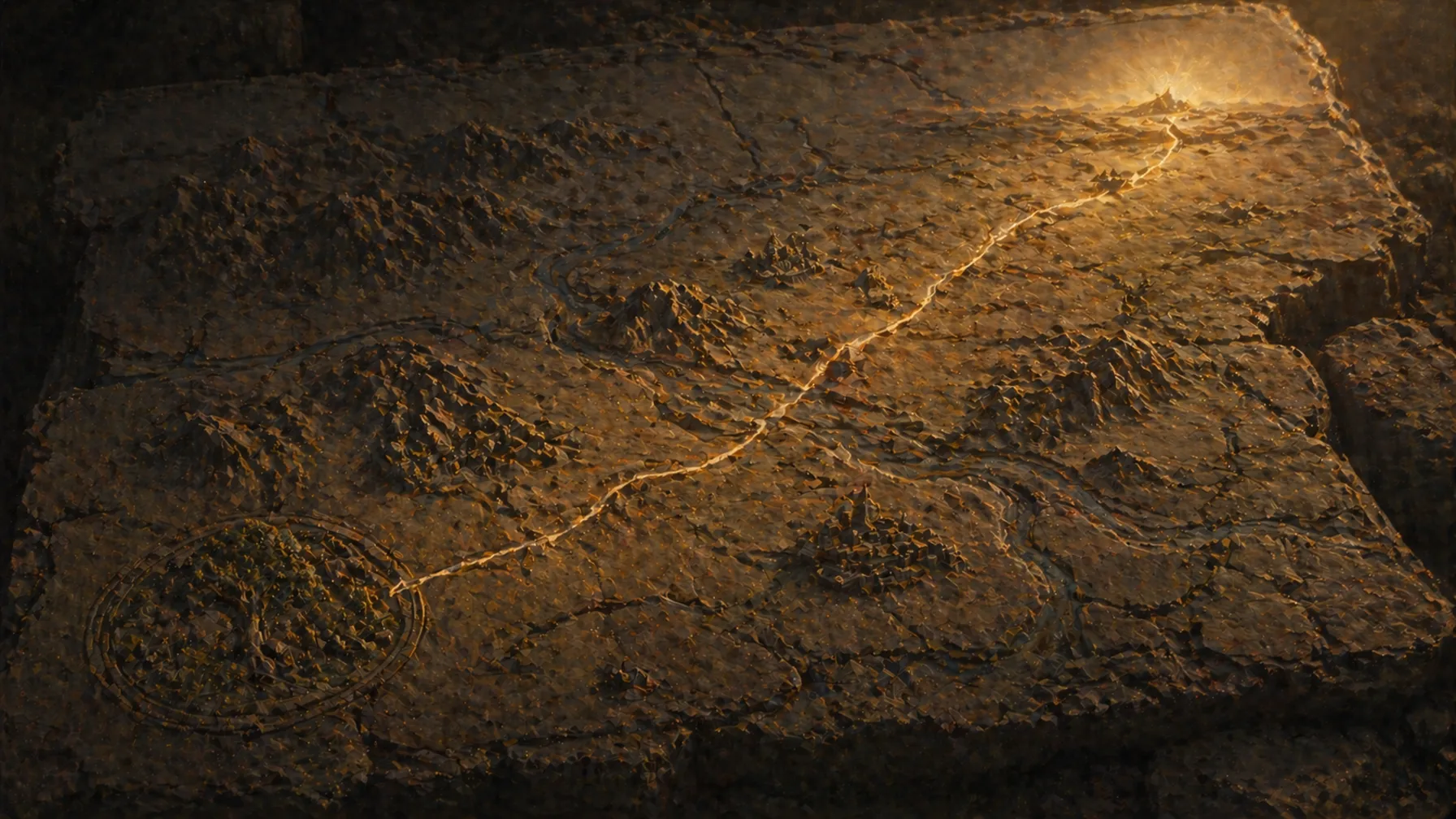
The Old Testament is one story in roughly six movements: a good world given work, a fracture that spreads, one family carrying a world-sized promise, redemption out of Egypt and the law that follows, a kingdom that rises and collapses, and judgment announced with hope left open. Knowing the arc is what makes the individual books legible.
Ask most churchgoers what the Old Testament is about, and they will name a character: Abraham, Moses, David. Ask a few more questions and the answers thin out. Kings blend into one another. The prophets become interchangeable voices of doom. Leviticus stops being read at all. That confusion is not a failure of intelligence. It is a failure of orientation. The Old Testament is one story told in six movements, and once you know where a passage sits in that arc, almost everything else about it sharpens.
How does the Old Testament story begin?
The opening movement runs through Genesis 1-2. God speaks a world into being and pronounces it good seven times. The climax is not land or sea or stars. The climax is a creature made in the divine image, assigned a vocation: "Be fruitful and multiply and fill the earth and subdue it" (Genesis 1:28). Image-bearers are not ornamental. They have a job. They represent the sovereign God by ruling his world wisely, extending the pattern of the garden outward. Work, creativity, and culture are built into creation from the first page, not tacked on after the fall. Holding on to this prevents a group from hearing the rest of the OT as pure disaster management.
What goes wrong, and how far does it spread?
Genesis 3 turns without warning. The couple refuses the boundary God set. Something breaks in the relationship between Creator and creature, and the effects radiate outward in every direction: shame between the man and woman, enmity introduced into the created order, exile from the garden, and death entering as a sentence. Genesis 4 to 11 tracks the expansion of that break. Cain kills Abel. Violence multiplies to the point of the flood. Then Babel: humanity unified in defiance, scattered in judgment (Genesis 11:1-9). By the end of chapter 11, the picture is of a world that has lost its vocation and cannot find its way back. That is exactly the context into which Genesis 12 explodes.
Why does God choose one family?
God calls Abram out of Ur and makes three commitments: a great name, a land, and a blessing that will reach "all the families of the earth" (Genesis 12:3). The scope is striking. God is not reducing his interest to one tribe. He is narrowing the channel through which he will address the problem that started in chapter 3. The covenant with Abraham, sealed in Genesis 15 when God alone passes between the pieces of the sacrifice, is unconditional. Isaac, Jacob, Joseph: the promise survives famine, slavery, and human failure at each turn. God is not improvising. He is building toward something.
What is the Exodus for?
Exodus is the Old Testament's central act of rescue. God brings Israel out of Egypt through blood on the doorposts, through a parted sea, and into the wilderness. The sequence matters: redemption first, then law. God does not say "obey these commands and I will save you." He saves, and then at Sinai he gives the law as the shape of a redeemed people's life. "I am the Lord your God, who brought you out of the land of Egypt" (Exodus 20:2) precedes every commandment. The law is given inside a relationship already established by grace. Israel fails to live it. The wilderness narratives are a long record of that failure. But the pattern of exodus-covenant becomes the template that prophets and apostles reach for again and again when they describe what God does for his people.
Why does the kingdom collapse?
Joshua through Kings covers roughly six centuries in accelerating decline. Israel enters the land. The judges cycle through unfaithfulness and rescue. The people demand a king. Saul fails. David receives a covenant: "Your house and your kingdom shall be made sure forever before me. Your throne shall be established forever" (2 Samuel 7:16). Solomon builds the temple. Then the kingdom splits. The north falls to Assyria in 722 BC. The south limps on until Babylon destroys Jerusalem in 586 BC. Two verses from Kings capture the verdict: Israel "did not believe in the Lord their God" and "walked in the customs of the nations" (2 Kings 17:8, 14). Exile was not a political accident. It was the covenantal consequence the prophets had been warning about.
How does the Old Testament end?
The prophets are not a separate section appended to the historical books. They are interpreters of the same story, speaking into specific moments of the arc. Isaiah, Jeremiah, Ezekiel, and the twelve minor prophets address the crisis of covenant failure and announce its consequences honestly. Exile is coming; exile is just.
But the prophets do not stop there. Isaiah 40:1-2 opens the second half of his book with comfort: "Comfort, comfort my people, says your God. Speak tenderly to Jerusalem, and cry to her that her warfare is ended, that her iniquity is pardoned." Beyond judgment lies restoration. Jeremiah promises a new covenant written on the heart (Jeremiah 31:33). Ezekiel sees dry bones reassembled and the Spirit breathed into them (Ezekiel 37:5). Isaiah's servant songs describe a figure who bears the iniquity of the people in his own body (Isaiah 53:6). The day of the Lord will bring purging, but it will also bring the permanent presence of God with his people. The OT does not end in despair. It ends leaning forward, straining toward a fulfillment it can describe but not yet produce.
Why does knowing the arc matter?
Every Old Testament passage sits somewhere in these six movements. A text from Leviticus sits in the Sinai movement: it is part of the law given inside the exodus-covenant, shaping the people God has already redeemed. A lament psalm sits in the kingdom movement, often in the gap between David's covenant and its visible failure. A passage from Amos sits in the prophetic movement, calling a prosperous but faithless Israel back to the terms of the Sinai covenant. Locating the text in the arc is not an academic exercise. It tells a group leader what question the passage is answering, what problem it is addressing, and where the author and audience stood in the long story of God and his people.
The arc also prevents two common errors in OT teaching. The first is reading every passage as a moral lesson, stripped of its narrative context. David kills Goliath becomes a talk about facing your giants. But 1 Samuel 17 sits in the arc as the moment when a promised king does what Israel could not do for itself, defeating the enemy that had paralyzed God's people for forty days. The second error is reading the OT as merely a backdrop to the New. Paul wrote that "whatever was written in former days was written for our instruction" (Romans 15:4). Former days means the full arc: creation to prophets. It was written for us, not merely about them.
Before your next session on any OT passage, locate it on the arc and ask your group: what did the people in this moment already know about God's story, and what were they still waiting for?
Sources
- Genesis through Malachi, read as a single narrative · The canonical order as the story's own shape
Terms in this article
Every passage each one appears in, with the definition attributed to its source.
Keep reading
Reading the Bible
Are Proverbs Promises? Wisdom and Its Edges
A proverb is a reliable pattern, not a guarantee. How Proverbs, Job and Ecclesiastes argue with each other on purpose, and how to teach that faithfully.
Reading the Bible
The Old in the New
Quotation, typology, and allusion. The three ways New Testament writers use the Old, and why Matthew 2:15 is the hardest case to explain.

Reading the Bible
The New Testament Arc
Gospels, Acts, Epistles, Revelation. Four movements that need each other, and what you lose reading any one of them on its own.


