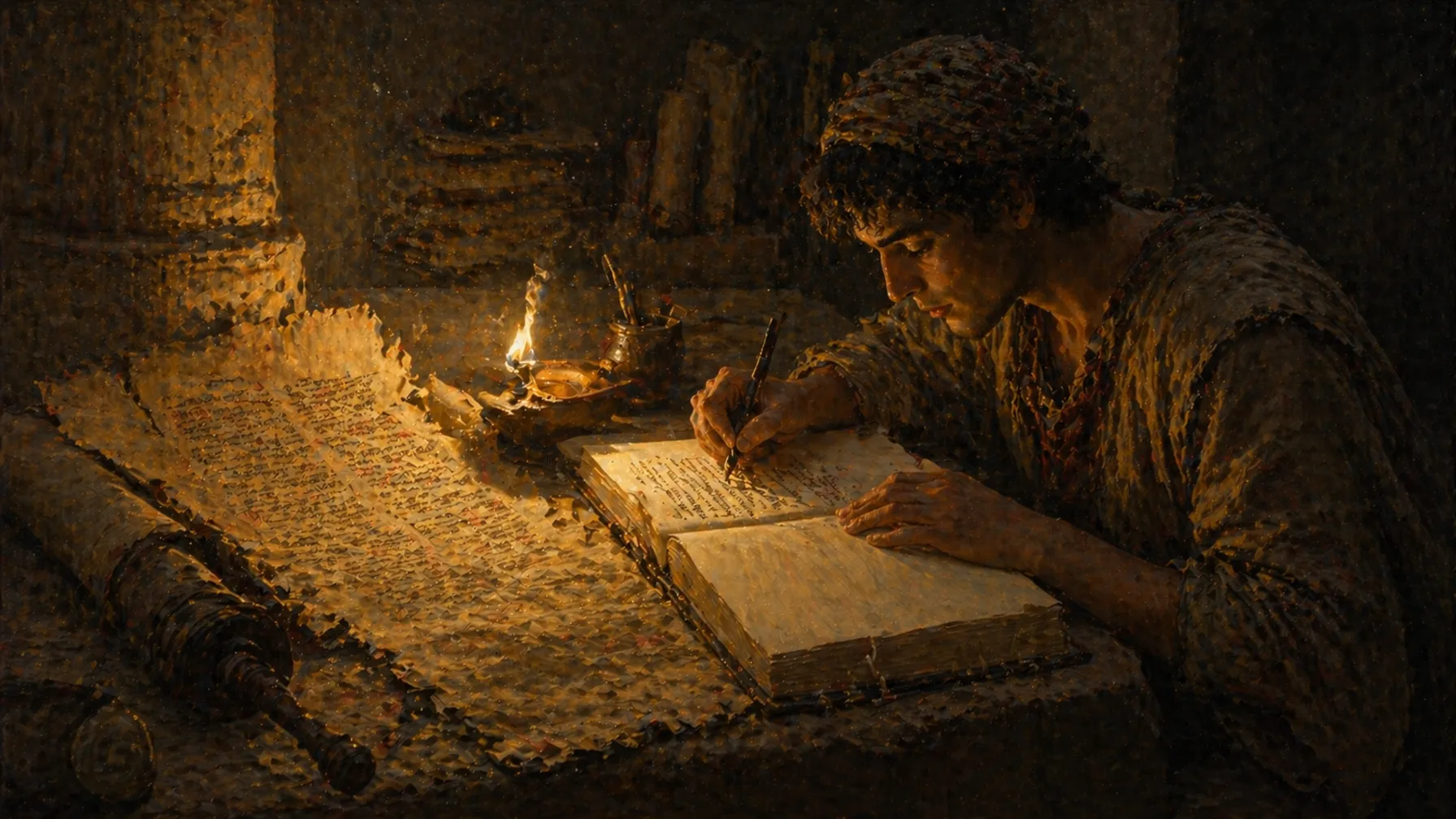
New Testament writers use the Old in three main ways. Direct quotation is the most visible, as when Philip reads Isaiah 53 and preaches Jesus. Typology treats a real person, event or institution as designed to prefigure something greater, a method Paul names himself. Allusion is the largest category and the least flagged, saturating a book like Revelation without a single formal citation.
Picture the scene. A government official from Ethiopia is riding home in a chariot, reading Isaiah aloud, and a preacher named Philip is sprinting alongside asking, "Do you understand what you are reading?" The official's answer is honest: "How can I, unless someone guides me?" (Acts 8:30-31). He was reading Isaiah 53, the suffering servant passage, one of the most haunting poems in the Hebrew Bible. Philip sat down and, starting from that very text, told him the good news about Jesus. That conversation is a window into how every NT author works. They did not leave their Bibles behind when they started preaching Christ. They read their Bibles and found Christ there.
Direct quotation: the OT speaking plainly
The most visible way NT authors use the OT is straight quotation. Philip reads Isaiah 53:7-8 and immediately sees Jesus, the one led like a sheep to the slaughter, the one whose life is taken from the earth. No interpretive gymnastics. The text was describing someone, and now Philip knows who.
Matthew does this with a pattern scholars call formula citations. Again and again he writes, "This was to fulfill what was spoken by the prophet." Jesus is born of a virgin: Isaiah 7:14. He is called out of Egypt: Hosea 11:1. He ministers in Galilee: Isaiah 9:1-2. Matthew is not cherry-picking proof texts. He is making an argument. The same God who was moving through Israel's whole history has now moved decisively in Jesus. The OT is not background noise. It is the plot that the gospel resolves.
Typology: patterns that point forward
Harder to spot, and more rewarding, is typology. A type is a real historical person, event, or institution that God designed to prefigure something greater. Paul names this method directly. Talking about Adam, he writes: "Adam was a type of the one who was to come" (Romans 5:14). The first Adam brought death through one act of disobedience. The second Adam, Christ, brings life through one act of obedience. The parallel is not accidental. God structured history so that the earlier figure would light up the later one.
Hebrews 7 does the same with Melchizedek, a mysterious priest-king who appears for two verses in Genesis 14 and is never explained. He has no recorded genealogy, no beginning, no end (Hebrews 7:3). The author of Hebrews sees in that silence something intentional. Melchizedek was shaped by God to picture a priest who holds office permanently, not by Levitical descent. Jesus is "a priest forever after the order of Melchizedek" (Hebrews 7:17, citing Psalm 110:4). The obscurity of the Genesis figure is not a loose end. It is the point.
Jesus himself uses typology in John 3. He tells Nicodemus, "As Moses lifted up the serpent in the wilderness, so must the Son of Man be lifted up, that whoever believes in him may have eternal life" (John 3:14-15). He is pointing to Numbers 21:8-9, the bronze serpent on a pole. Israel was dying from snake bites. Anyone who looked at the bronze serpent lived. Jesus sees his own crucifixion in that image. The lifting up on a pole, the gaze that saves, the death that heals. Same God, same pattern, greater reality.
When the OT meant more than it knew
The Matthew 2:15 citation is worth stopping on because it is the most challenging case. Matthew writes that Jesus' family fled to Egypt and returned, "to fulfill what the Lord had spoken by the prophet, 'Out of Egypt I called my son'" (Hosea 11:1). But read Hosea 11:1 in its own context. It is not a prediction. It is a retrospective: God recalling the exodus, calling Israel his son, mourning how that son kept turning to idols. How can Matthew claim this as fulfilled in Jesus?
Because Matthew reads Hosea the way the apostles read all of Scripture: as a story about God and his son. Israel was God's son in Hosea. Israel failed. Jesus is the true Son, who succeeds where Israel stumbled. He recapitulates the whole story of God's people, going down to Egypt and coming back up, passing through the waters of the Jordan, spending forty days in the wilderness, giving the law from a mountain. Matthew is not misreading Hosea. He is reading it at full depth, seeing the Israel-pattern fulfilled in the one who perfectly embodied what Israel was called to be.
Allusion: the OT saturating the NT
Beyond explicit quotation and named typology, the NT is saturated with OT echoes that the authors never flag with a citation. Revelation is the extreme case. Scholars estimate that Revelation contains over 500 allusions to the Hebrew Bible without ever quoting it directly. Open Revelation 1. The seven golden lampstands echo the menorah in the tabernacle. The "one like a son of man" in Revelation 1:13 comes from Daniel 7:13. The words coming from his mouth like a sharp sword recall Isaiah 49:2. By Revelation 5, the "Lamb standing, as though it had been slain" (Revelation 5:6) carries the weight of every Passover sacrifice, every Day of Atonement, and the suffering servant of Isaiah 53, all at once.
John assumes his readers know their Hebrew Bible. Every image he draws is borrowed from it, and the borrowing is the argument. The story of Israel is not over. It is reaching its climax. Jesus is not a new God announcing a new religion. He is the fulfillment of the one story that has been running since Genesis.
Why none of this is optional
This is not a method for specialists. It is the method the apostles used instinctively, because for them the OT was the only Scripture that existed. When Paul writes that "all Scripture is breathed out by God" (2 Timothy 3:16), he means the Hebrew Bible. The NT authors did not think they were replacing it. They thought they were showing what it had always been about.
A group that never reads the OT will read the NT partially at best. Romans 5 on Adam and Christ is thin without Genesis 3. Hebrews is nearly opaque without Leviticus. Revelation is bewildering without Daniel, Ezekiel, and the Psalms. The NT writers were not making connections for rhetorical effect. They believed God had written one story across two testaments, and that the second half only makes sense when you have read the first. As Jesus told the two disciples on the road to Emmaus, "beginning with Moses and all the Prophets, he interpreted to them in all the Scriptures the things concerning himself" (Luke 24:27). That is the reading method. Start anywhere in the OT and follow it to Christ.
For how genre shapes the way OT passages should be read before you trace their NT echoes, see Reading by Genre and Why Context Matters.
Before your group meets this week, pick one NT passage you plan to teach, find its OT quotation or allusion, read that OT passage in its original setting, and then ask: what does seeing the first half add to what the NT author is claiming?
Terms in this article
Every passage each one appears in, with the definition attributed to its source.
Keep reading
Reading the Bible
The Gospel Through the Canon
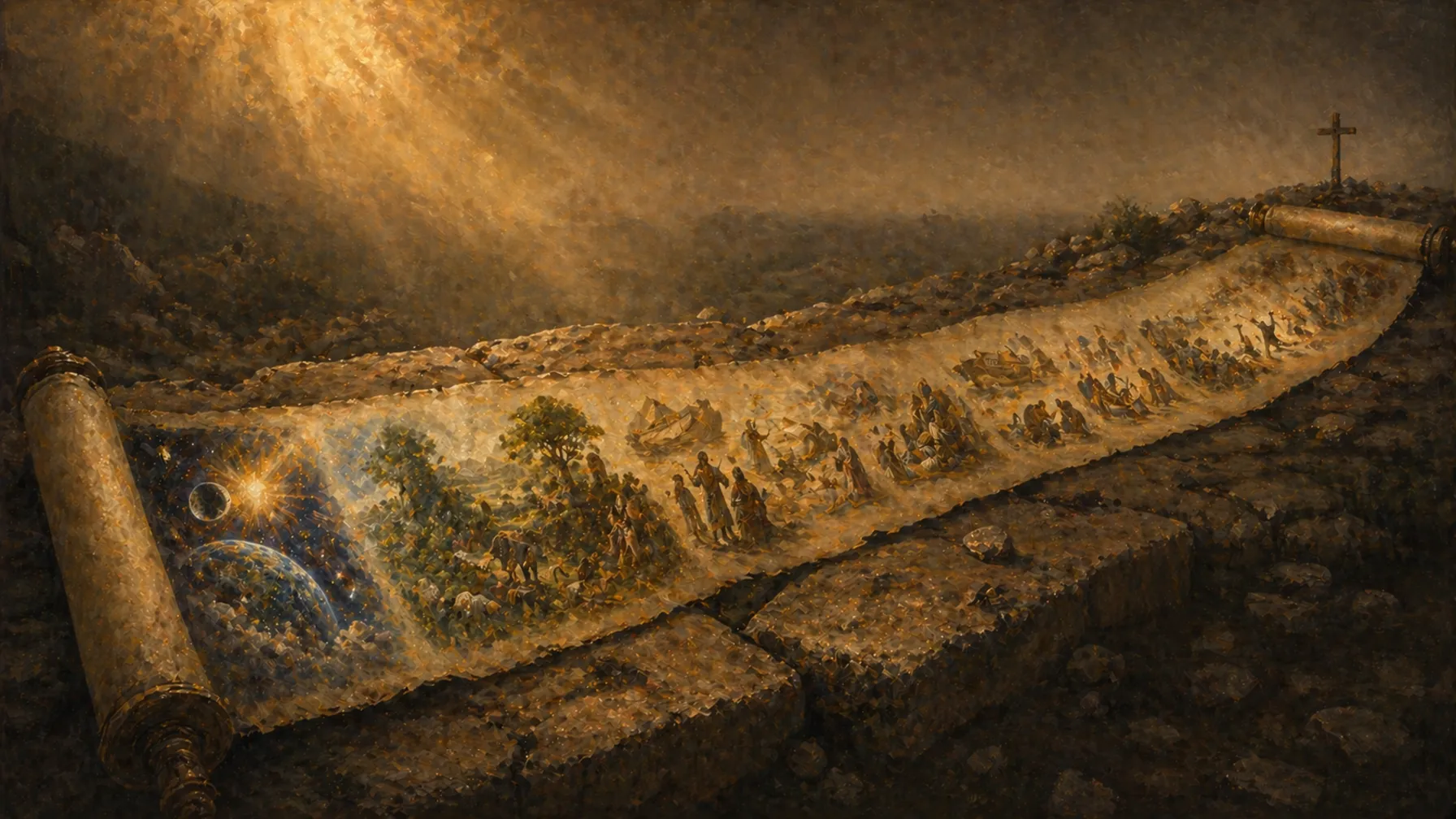
Jesus walked the Emmaus road and read himself out of Moses and the Prophets. How the promise narrows across the canon, and where the method goes wrong.
Reading the Bible
What Is the Old Testament About? The Story in Six Movements
Not a collection of characters but one story: creation, fracture, promise, redemption, kingdom, collapse with hope. The shape that makes the books cohere.
Reading the Bible
The New Testament Arc
Gospels, Acts, Epistles, Revelation. Four movements that need each other, and what you lose reading any one of them on its own.


