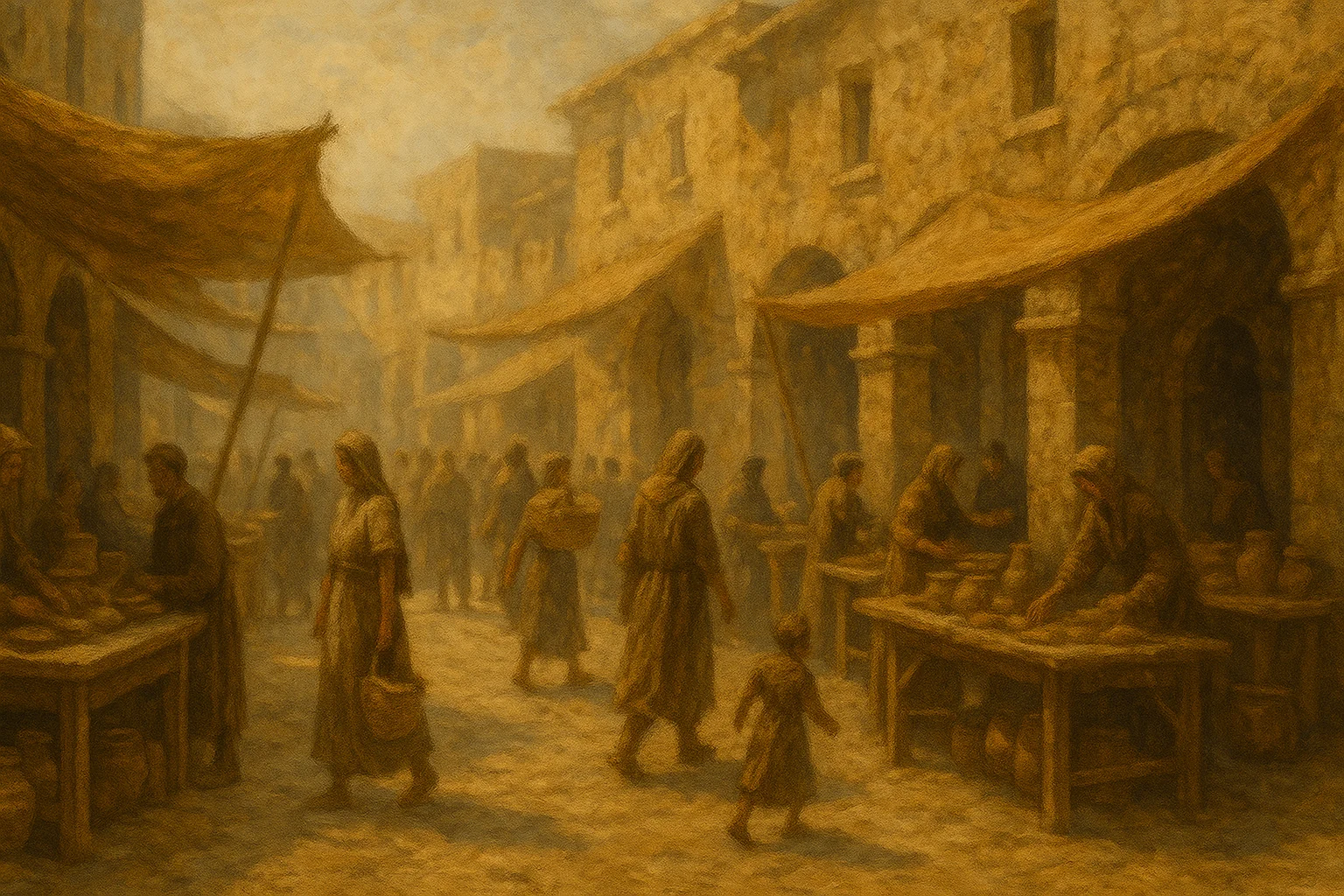
Context matters because a passage has one meaning, the one its author intended for a real audience, even though it can be applied many ways. Reading in context means asking who wrote it, to whom, when, and why before asking what it means for you. Context does not change the meaning. It reveals it.
If you've ever walked into the middle of a conversation, you know how easy it is to misread what's being said. Imagine hearing someone say, "Put it in the trunk." Without context, your mind starts guessing: a car, a tree, an elephant? Realize they're standing in a garage next to a car and everything suddenly makes sense. The context didn't change the meaning. It revealed it.
Even between people who know each other well, communication breaks down without context. Most misunderstandings in conversation don't come from the words themselves but from missing the story around them: what was meant, when it was said, why it was said. The same is true with Scripture. Without its setting, we start guessing at meaning, and our guesses usually say more about us than about God.
Does a verse have one meaning or many?
When Paul writes, he means one thing: the truth God intended to communicate through him to a real audience in a real moment. Our calling isn't to invent new meanings, it's to listen closely enough to find what the author meant under the Spirit's guidance. There may be many ways to apply a verse, but its core meaning is anchored in God's original intent.
Take Paul's line to the Philippians, "Our citizenship is in heaven" (Philippians 3:20). He isn't contrasting earth and heaven as places. Philippi was a Roman colony where citizenship was a badge of honor, a symbol of belonging, status, and security. By choosing that word, Paul reminded believers who knew exactly what Roman citizenship meant that their true allegiance was to Christ, not Caesar. What sounds like spiritual poetry becomes a quiet act of resistance once you see the world he was writing into.
Why did God give Scripture through human authors?
This matters because the way God gave His Word is the way He gives Himself: through relationship, story, and history. Scripture is fully divine and fully human. God didn't drop His words from heaven. He breathed them through prophets, poets, and apostles shaped by their own time, culture, and language.
Through their lives, He revealed His truth for every generation that would follow. That's what makes Scripture alive. It isn't a distant esoteric code waiting to be decoded like gnosticism. It's a living Word that still speaks with clarity and power when read as it was written, in its original context.
What does it look like to read the Bible in context?
When you read with context, you're not just studying better, you're honoring the way God chose to speak. You're stepping into the world of the original hearers to hear His voice the way He intended. As with friends or family, our communication with God can become clouded by our assumptions when we ignore context. God has never been the unclear one. We've been the ones misunderstanding His character and His ways. When we listen to His Word as it was first spoken, the conversation becomes clear, grounded, and alive.
Once you see how God spoke through time and story, the next step is to read with that same attentiveness. In Contextual Study, you'll learn how to do exactly that.
Sources
- Gordon D. Fee and Douglas Stuart, How to Read the Bible for All Its Worth (Zondervan, 4th ed. 2014) · The standard introduction to meaning and application
- Philippians 3:20, in its setting as a letter to a Roman colony · Acts 16:12 identifies Philippi as a Roman colony
Terms in this article
Every passage each one appears in, with the definition attributed to its source.
Keep reading

Hermeneutics
Common Interpretive Errors
Proof-texting, allegorizing, over-applied promises, and flattening narrative into a moral. The errors that ruin teaching before anyone speaks.

Hermeneutics
Word Studies Done Right
The dunamis-means-dynamite claim is wrong, and so is agape versus philia. How to run a Greek word study that holds up.

Hermeneutics
Eisegesis vs Exegesis: What Is the Difference?
Exegesis draws meaning out of the text. Eisegesis reads meaning into it. How the drift happens to sincere readers, and the habits that keep you honest.


