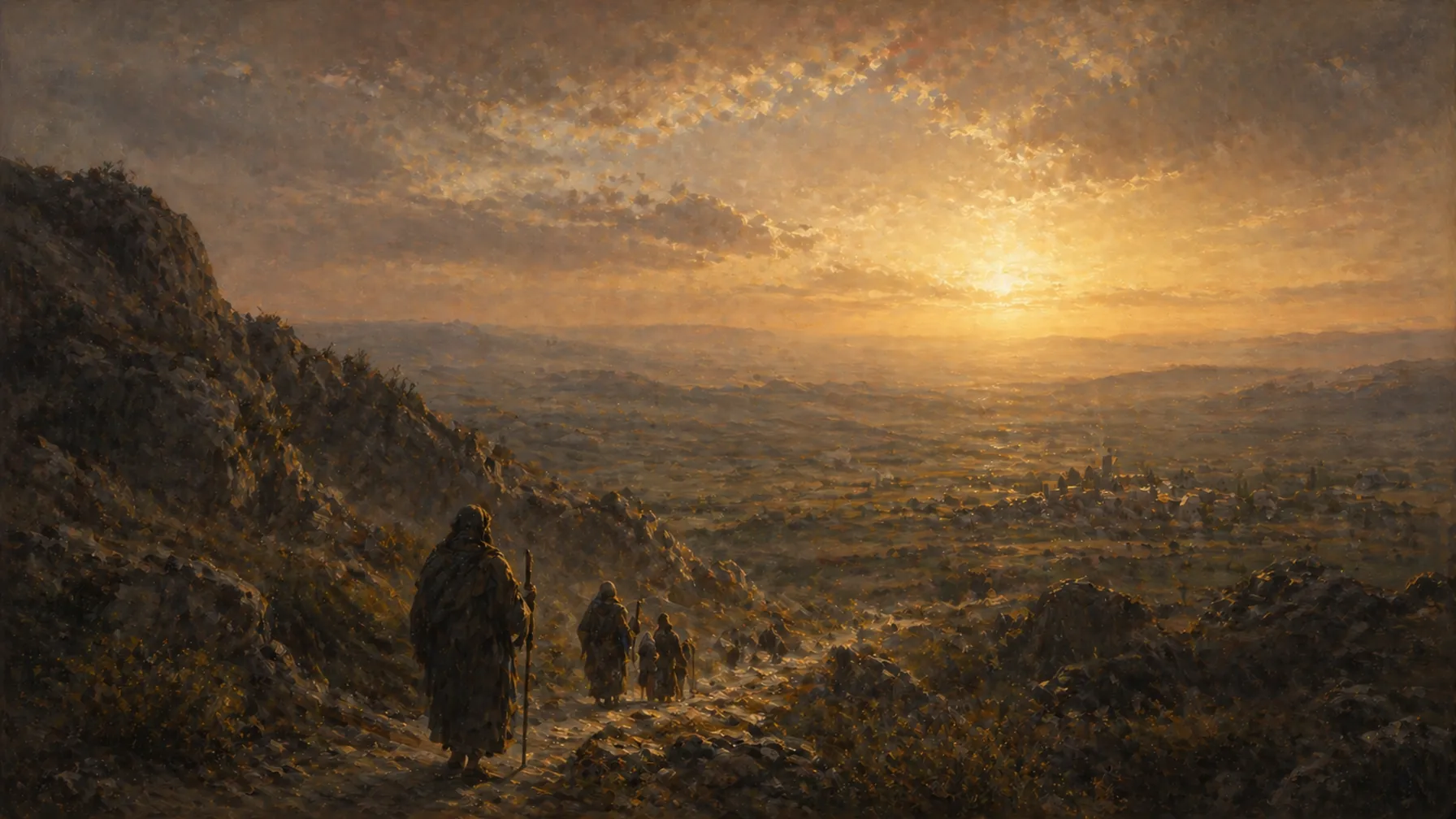
Exile is one of Scripture's load-bearing patterns. Adam's expulsion sets it: what is lost is a relationship rather than a location. Israel's Babylonian exile repeats it, and the return under Ezra stays incomplete because the glory Ezekiel watched depart never visibly returns. Revelation 21:3-4 closes the arc that Genesis 3 opened.
The last image of Eden is a closed gate. Cherubim stationed at the entrance, a flaming sword turning every direction, and two people walking away from the only home they had known (Genesis 3:23-24). This is not just the conclusion of one story. It is the opening of the longest thread in the Bible: the thread of exile, the longing for home, and the one who finally leads his people back.
The gate that closed
Adam's expulsion establishes the pattern. Sin produces exile from God's presence. What was lost was not a location but a relationship: walking with God in the cool of the day, which became impossible once the breach opened. Every exile that follows in Scripture echoes this first one, whether it is Abraham leaving his homeland, Joseph in Egypt, or Israel in Babylon. The movement is the same: separation, distance, longing, and the hope of a way back.
A nation rehearses the pattern
Israel's exile to Babylon is the most developed version of Adam's story in the Old Testament. Covenant faithlessness leads to removal from the land. But Isaiah 40:1-5 sounds a note of comfort that is about more than national restoration: "Comfort, comfort my people, says your God. Speak tenderly to Jerusalem, and cry to her that her warfare is ended, that her iniquity is pardoned." A voice cries in the wilderness, preparing the way of the Lord. This is the language of a return greater than any political homecoming.
The incomplete return
Ezra and Nehemiah lead a physical return from Babylon. The temple is rebuilt. The walls go up. But something is absent. Ezekiel had watched the divine glory depart from the first temple in stages (Ezekiel 10:18-19, 11:23). That glory never visibly returns to the rebuilt temple. The return is partial. The people are back in the land, but the presence has not fully returned. The prophets keep pointing forward.
The true exile who returns
Matthew 2:15 quotes Hosea 11:1 ("Out of Egypt I called my son") and applies it to Jesus returning from Egypt as a child. Hosea was describing Israel's exodus. Matthew is saying: Jesus is the true Israel, reliving the pattern of exile and return in his own person. Where Israel failed, he succeeds. He goes further into exile than any Israelite ever did, bearing the God-forsakenness of the cross (Matthew 27:46), and the resurrection is the definitive return from the land of death back into life.
Paul reads the same pattern in Romans 5: where Adam led humanity into exile from God, Christ leads them back into life and reconciliation. The two Adams stand at either end of the story, and Christ's exile and return reverses what the first Adam began.
Sojourners still
Peter addresses his letters to "elect exiles of the Dispersion" (1 Peter 1:1) and calls believers "sojourners and exiles" (1 Peter 2:11). This is not a figure of speech for feeling out of place. It is a theological description of where the church stands in the narrative. The final return has not yet arrived. We live between the resurrection, which guarantees it, and the consummation, which completes it. The pilgrim posture of the Christian life makes sense only inside this story.
The final homecoming
Revelation 21:3-4 closes the arc that opened in Genesis 3: "Behold, the dwelling place of God is with man. He will dwell with them, and they will be his people, and God himself will be with them as their God. He will wipe away every tear from their eyes, and death shall be no more, neither shall there be mourning, nor crying, nor pain anymore, for the former things have passed away."
The gate that closed in Eden opens again. Not to the same garden but to a city where the presence that was lost is fully and permanently restored. The exile that began with two people walking away from God ends with God himself living among his people without barrier.
This week, read 1 Peter 2:11 with your group and ask: what does it mean for your everyday life that you are an exile, and what does it mean that you know where home is?
Terms in this article
Every passage each one appears in, with the definition attributed to its source.
Keep reading
Reading the Bible
The Kingdom of God
Kingdom means reign, not territory. What already and not yet means in practice, and why the church is not the same thing as the kingdom.
Reading the Bible
Temple and Presence
Eden, tabernacle, temple, Christ, the church, and then no temple at all. How God's dwelling with people moves across the whole Bible.
Reading the Bible
Are Proverbs Promises? Wisdom and Its Edges
A proverb is a reliable pattern, not a guarantee. How Proverbs, Job and Ecclesiastes argue with each other on purpose, and how to teach that faithfully.


