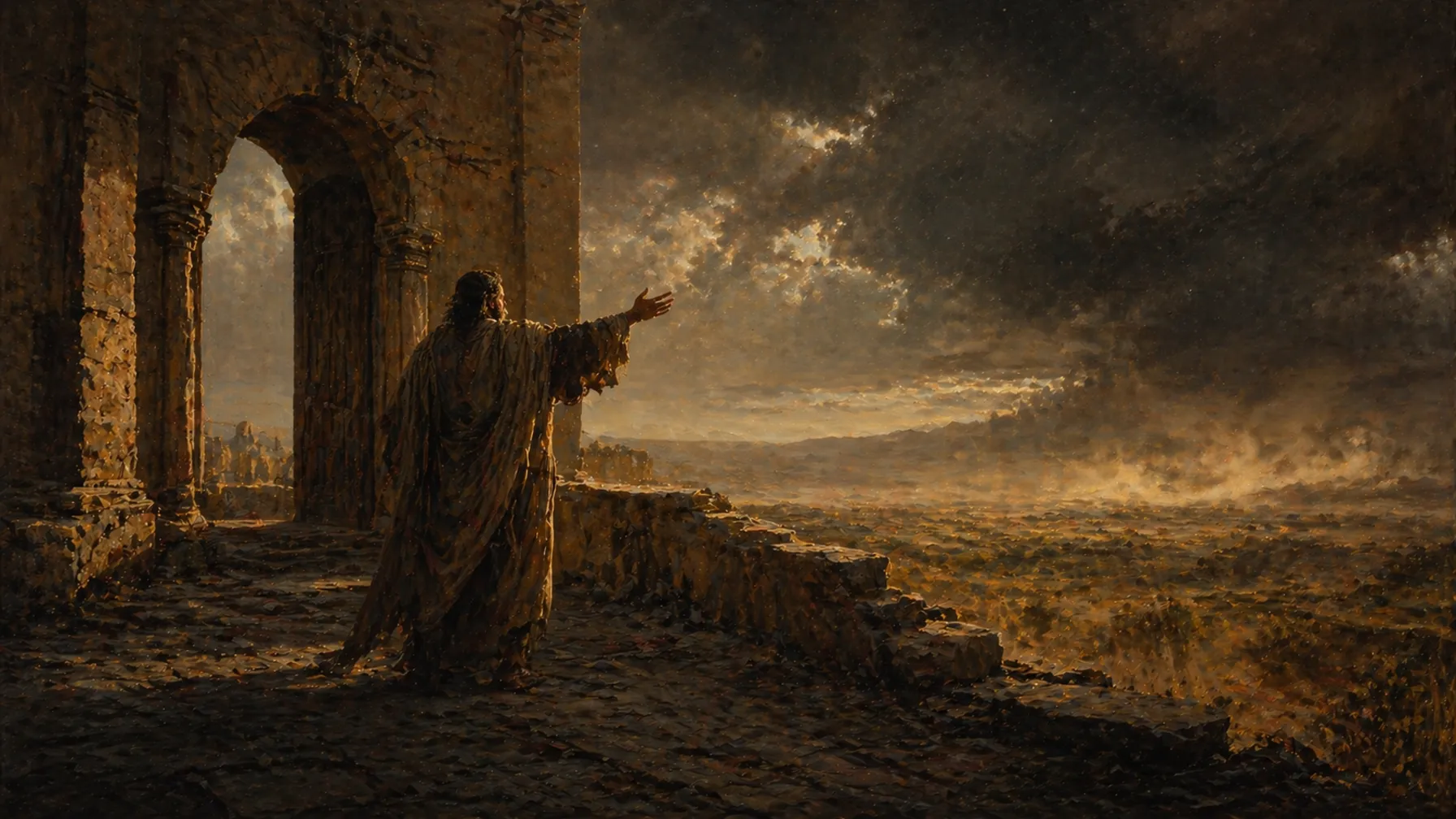
The prophets are covenant prosecutors more than forecasters: most of what they say addresses the immediate situation of their own hearers. Amos 5 indicts the worship life of 8th-century Israel rather than describing a distant era. Predictive material is genuinely there, and Isaiah 53 is among the clearest, but it grows out of the covenant lawsuit rather than floating free of it.
Picture Amos standing in the royal sanctuary at Bethel, an outsider from Tekoa who tends sycamore trees, delivering a verdict to a prosperous nation. The crowds are full. The festivals are packed. The music is loud. And the word he brings isn't "here is what will happen in two thousand years." It's "you have sold the righteous for silver, and the needy for a pair of sandals" (Amos 2:6). That's a prosecution, not a prediction. The distinction changes how you read almost everything in the prophetic books.
Prosecutors, not predictors
Modern readers tend to come to the prophets looking for forecasts. That framing is understandable but mostly wrong. Roughly eighty percent of prophetic material addresses the immediate situation of the prophet's audience, calling Israel or Judah back to the terms of their covenant with God. The technical Hebrew form is the rib, a covenant lawsuit in which God plays the role of the prosecuting party before a divine court. Isaiah 1:2-4 opens in exactly that register: "Hear, O heavens, and give ear, O earth; for the LORD has spoken: Children have I reared and brought up, but they have rebelled against me." Creation itself is summoned as witness. The charge isn't ignorance of the future. It's covenant breach in the present.
This matters because it tells you what the prophets thought they were doing. They weren't calculating timelines. They were bringing a covenant complaint to a people who knew the terms and were violating them. The prophet's authority came precisely from that covenant framework, not from the accuracy of predictions taken in isolation.
Forth-telling: the dominant mode
Take Amos 5 as a test case. Read the whole chapter slowly. What you find is an indictment of 8th-century northern Israel's worship life: elaborate festivals, burnt offerings, and solemn assemblies that God says he despises. The reason isn't that worship is wrong. It's that the same people offering sacrifices are trampling the poor and pushing the afflicted out of the way (Amos 5:12). Verse 24 delivers the verdict in one of the most memorable sentences in all of Scripture: "But let justice roll down like waters, and righteousness like an ever-flowing stream." That isn't a prediction. It's a demand addressed to people who are alive and choosing badly right now.
Micah 6:8 works the same way. "He has told you, O man, what is good; and what does the LORD require of you but to do justice, and to love kindness, and to walk humbly with your God?" The word "told" points backward to the covenant already given, not forward to something being revealed for the first time. Micah is reminding people of obligations they already hold. His job isn't to predict the future. It's to hold people accountable to a past they're trying to forget.
Predictive texts: grounded, not floating
None of this means forward-pointing prophecy is absent or unimportant. Isaiah 53 is among the most strikingly predictive passages in the whole Bible, and the New Testament writers quote it repeatedly to explain the cross. Even here, the prediction is embedded in the Servant Songs, which are themselves embedded in Isaiah's larger covenant argument about a God who will not abandon his people despite their unfaithfulness. The suffering servant answers the question the exiles were asking in real time: does God still intend to redeem us? Isaiah 53 doesn't float free of its historical moment. It speaks into it, and then speaks beyond it. Both moves are real. Neither cancels the other.
Isaiah 7:14 is worth pausing on, because it's often read as straightforward messianic prediction and nothing more. The text has an immediate context. King Ahaz is terrified by the Syro-Ephraimite coalition threatening Jerusalem. God offers a sign: a young woman will conceive and bear a son named Immanuel, and before that child is old enough to reject evil and choose good, the two kings Ahaz fears will be gone (Isaiah 7:15-16). There is a near-term fulfillment tied to an 8th-century military crisis. Matthew 1:23 then quotes Isaiah 7:14 to explain the virgin birth of Jesus, seeing in it a deeper meaning the original words could carry but that only became visible in the light of the incarnation. Both readings are legitimate. The near-term reading doesn't disqualify the later one. The later one doesn't erase the near-term one. To read predictive prophecy well is to hold both without collapsing the text into a single point on a timeline.
Jeremiah's letter and the present tense of hope
Jeremiah 29:4-7 is a striking case of prophetic forth-telling aimed at people who want nothing more than a prediction of imminent rescue. The exiles in Babylon are expecting a short stay. Jeremiah writes to tell them the opposite: "Build houses and live in them; plant gardens and eat their produce. Take wives and have sons and daughters." Then comes the sentence that must have landed like cold water: "But seek the welfare of the city where I have sent you into exile, and pray to the LORD on its behalf, for in its welfare you will find your welfare." This is covenant faithfulness applied to a specific, painful, present-tense situation. There is a future in the letter, the seventy years, the return. But the primary word is for right now: live here, invest here, pray here. The prophet isn't primarily a forecaster. He's a pastor with a covenant frame.
How to read predictive material without flattening it
The temptation when reading predictive passages is to skip straight to the fulfillment and treat the Old Testament text as a kind of encrypted label on a New Testament event. That move costs you the depth of both testaments. The prophecy meant something to the people who first heard it. God wasn't speaking past them to a future audience while they stood there holding a text they couldn't understand. Read the predictive material first in its own moment. Ask what promise or warning it carried for the original hearers. Then ask how the New Testament picks it up and what further meaning the fulfillment reveals. That sequence respects the integrity of the whole story.
This approach also protects against the habit of reading the prophets purely as a code for current events, matching headlines to verses and calling it interpretation. When you anchor prophecy in its covenant context, you stop asking "which nation does this predict?" and start asking "what does this reveal about the character of God and the terms of his relationship with his people?" That second question is more faithful to what the prophets were actually doing. For a broader look at how genre shapes these questions, see Reading by Genre; and for the historical grounding underneath this, see Why Context Matters.
Before your group works through any prophetic book this term, read the opening chapter aloud and mark every verse that addresses the prophet's immediate audience directly. Count them. Then count the forward-pointing verses. The ratio will reframe every session that follows.
Terms in this article
Every passage each one appears in, with the definition attributed to its source.
Keep reading

Reading the Bible
What Is the Old Testament About? The Story in Six Movements
Not a collection of characters but one story: creation, fracture, promise, redemption, kingdom, collapse with hope. The shape that makes the books cohere.
Reading the Bible
The Old in the New
Quotation, typology, and allusion. The three ways New Testament writers use the Old, and why Matthew 2:15 is the hardest case to explain.
Reading the Bible
The New Testament Arc
Gospels, Acts, Epistles, Revelation. Four movements that need each other, and what you lose reading any one of them on its own.


