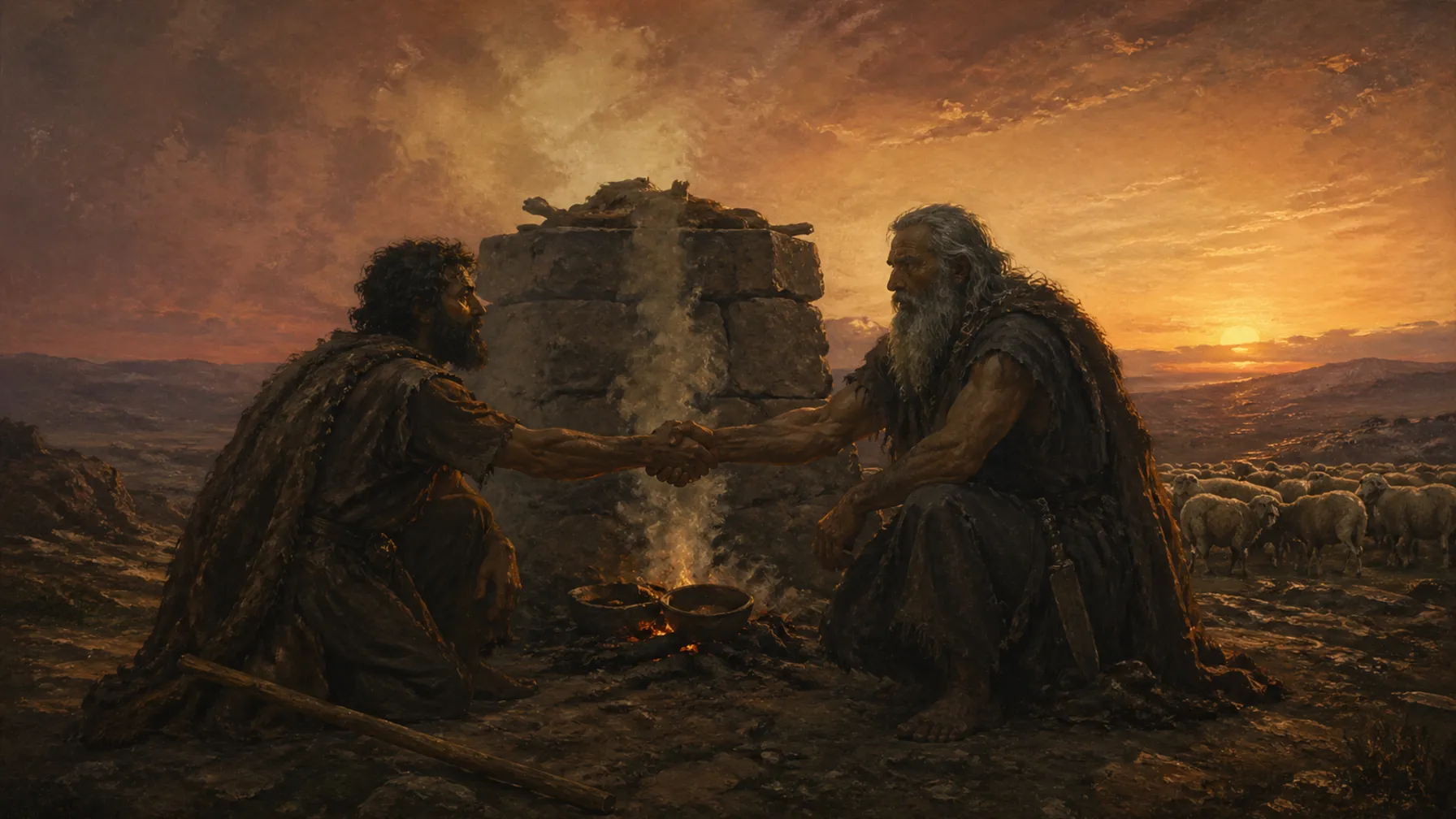
The covenants are what hold the Bible together, and they narrow steadily: from all nations to one family, one family to one nation, one nation to one tribe, one tribe to one king, and finally to one son. Sinai exposed the problem the human heart could not solve and Jeremiah 31 answered it. Paul says all the promises of God find their Yes in Christ.
Most first-time readers of the Bible experience it as a library of disconnected books. Genesis feels nothing like Leviticus. Ruth feels nothing like Ezekiel. Then you reach Paul's letters, which assume you have read everything before them, and the confusion compounds. What holds 66 books together? The answer is not a theme but a structure: a series of binding agreements between God and his people that escalate from creation to new creation, each one building on the last.
A promise before any conditions
The first covenant after the fall is the Noahic. God establishes it with Noah and every living creature: "I establish my covenant with you, that never again shall all flesh be cut off by the waters of the flood" (Genesis 9:11). No conditions are attached to the rainbow. God simply commits. This establishes something important before anything else: God's covenant dealings begin with unconditional grace, not with conditions that must be met.
One family, all nations
With Abraham, God narrows his focus and expands his promise at the same time. He calls one man out of Mesopotamia and commits to make from him a great nation, to give his descendants a land, and to bless all the families of the earth through him (Genesis 12:1-3). The promise is unconditional. In Genesis 15, God passes between the pieces of the covenant sacrifice alone, while Abraham sleeps. Only one party walks through. If this covenant ever breaks, God bears the liability.
Paul picks this up in Galatians 3:16-17: the promise was made to Abraham and his offspring singular, meaning Christ. The Mosaic law that came 430 years later does not annul what was unconditionally given. The promise outlasts the law.
The covenant that exposes the problem
At Sinai, something new happens. God gives Israel his law and establishes a national covenant: "if you will indeed obey my voice and keep my covenant, you shall be my treasured possession" (Exodus 19:5). This covenant is conditional. The people respond with confidence: "All that the Lord has spoken we will do" (Exodus 24:7). They have not been at Sinai for forty days before the golden calf appears.
Jeremiah 31:31-32 delivers the verdict centuries later: "not like the covenant that I made with their fathers on the day when I took them by the hand to bring them out of the land of Egypt, my covenant that they broke." The Mosaic covenant does not solve the human problem. It diagnoses it. Israel needed a better covenant, one that addressed the heart rather than regulating the exterior.
A throne without an end
David wanted to build God a house. God's response was to build David one instead: "Your house and your kingdom shall be made sure forever before me. Your throne shall be established forever" (2 Samuel 7:16). The Davidic covenant promises an eternal dynasty. Solomon's temple fell. The Davidic line was exiled. But the promise did not expire. Luke 1:32-33 traces the fulfillment to a child born in Bethlehem: "The Lord God will give to him the throne of his father David, and he will reign over the house of Jacob forever, and of his kingdom there will be no end."
Written on the inside
Jeremiah 31:33 announces the covenant that answers every failure of the ones before it: "I will put my law within them, and I will write it on their hearts." The problem with Sinai was not the law. The problem was the heart that could not keep it. The new covenant does not lower the standard. It changes the person.
At the last supper, Jesus took the cup and said, "This cup that is poured out for you is the new covenant in my blood" (Luke 22:20). Hebrews confirms the logic: Christ is "the mediator of a better covenant, established on better promises" (Hebrews 8:6). The old covenant was provisional. This one is permanent.
All of them, yes, in him
Paul writes that "all the promises of God find their Yes in him" (2 Corinthians 1:20). The covenants do not stack randomly. They narrow: from all nations to one family, from one family to one nation, from one nation to one tribe, from one tribe to one king, from one king to one son. The entire structure converges on Christ. He is the seed of Abraham through whom all nations are blessed (Galatians 3:16). He is the Son of David who sits on an eternal throne. He is the mediator of the new covenant whose blood seals what Jeremiah promised.
Faithful evangelicals differ on what convergence in Christ means for the original recipients of the promises. Some read the Old Testament national and land promises as terminating in Christ alone, fulfilled spiritually in him and his church. Others hold that those promises continue to await a literal fulfillment for ethnic Israel, with Christ as their guarantor rather than their full and final terminus. The sketch above traces the typological line without intending to foreclose either reading.
Reading the Bible through the covenant structure does not flatten the diversity of its books. It gives that diversity a frame. Each book sits somewhere in the story of God keeping his word.
This week, trace the word "covenant" through Genesis 9, Genesis 15, 2 Samuel 7, and Luke 22:20 with your group, and ask what each one adds to the picture of who God is.
Terms in this article
Every passage each one appears in, with the definition attributed to its source.
Keep reading

Reading the Bible
The Kingdom of God
Kingdom means reign, not territory. What already and not yet means in practice, and why the church is not the same thing as the kingdom.

Reading the Bible
Temple and Presence
Eden, tabernacle, temple, Christ, the church, and then no temple at all. How God's dwelling with people moves across the whole Bible.
Reading the Bible
Prophets as covenant voice
Roughly eighty percent of prophetic material addresses its own moment, not the future. Why the prophets are prosecutors before they are predictors.


