
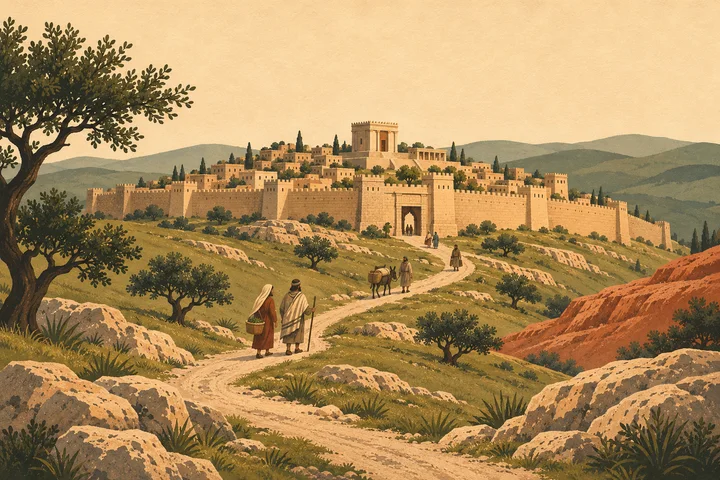
Judah
Jerusalem
After the kingdom split, Jerusalem remained the capital of Judah and the site of the temple. It lies south of Samaria and west of the Dead Sea.
Explore Jerusalem, Samaria and Dan on the regional map, then play the Siege of Samaria to see one event from the region’s history.
After the kingdom split, Jerusalem remained Judah's capital. Omri established Samaria as the northern kingdom's capital, and Assyria later captured it. 1 Kings 12:16-241 Kings 16:23-242 Kings 17:5-6

Judah
After the kingdom split, Jerusalem remained the capital of Judah and the site of the temple. It lies south of Samaria and west of the Dead Sea.
The painted landscape is schematic. The movement is schematic.
Take the map to your next study
Both views in a two-page handout.
After the kingdom split, Jerusalem remained the capital of Judah and the site of the temple. It lies south of Samaria and west of the Dead Sea.
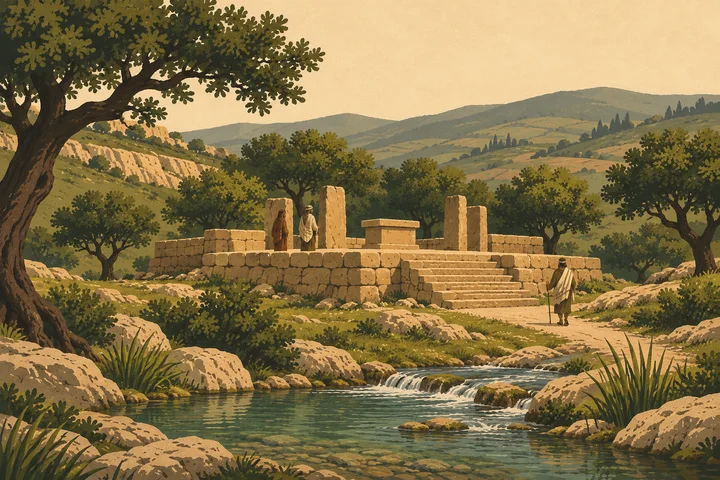
Jeroboam set up worship sites at Dan and Bethel. Dan is the northernmost of the three places on this map, near the headwaters of the Jordan.
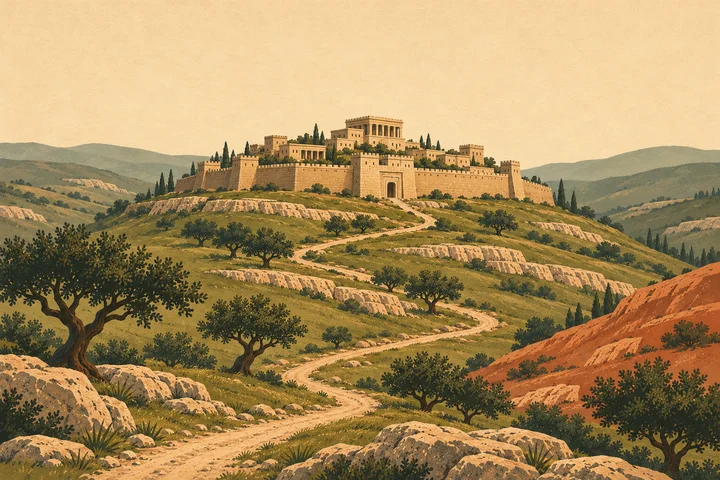
Omri bought the hill of Samaria and built a city there. It became the capital of the northern kingdom and lies in the highlands north of Jerusalem.
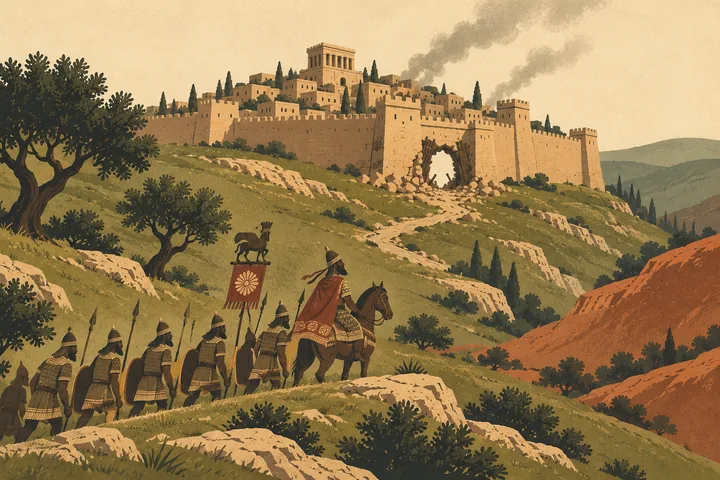
The Assyrian army besieged Samaria for three years. After the city fell in 722/721 BCE, Assyria deported Israelites from their land. The animation illustrates an approach to the city.
Israel was the northern kingdom, whose later capital was Samaria. Judah was the southern kingdom, with Jerusalem as its capital. First Kings 12 recounts the split.
It illustrates the Assyrian approach to Samaria. Second Kings 17 describes the siege and the fall of the northern kingdom. The animated approach is schematic.
First Kings 12 describes Jeroboam setting up a golden calf at Dan. The map marks Dan as a northern worship center.
First Kings 12 recounts the division of the kingdoms. Second Kings 17 describes Assyria's siege of Samaria and the deportation that followed.
Read it in context
Follow the story of Israel and Judah with published commentary and Bible dictionary entries alongside the verses in Protos.

Testimonies from pastors and Bible teachers

“Great app for diving into Scripture wherever you are. It makes it easy and convenient to study on the go.”

Pastor Darren Raynald
Pastor, MountainHouse ChurchTeaches at Portland Bible College

“Been using Protos for months now. Protos is an amazing Bible study app for anyone who wants to grow deeper in God's Word. I love how it helps me understand Scripture beyond simply reading the verses, providing helpful historical context, commentary, and insights into the original Hebrew and Greek. The resources make it easier to engage with the Bible and grow in understanding.”

Pastor Jason Layantara
Teaching Pastor, MountainHouse ChurchM.A. in Christian Leadership · Bible class teacher, Lake Tahoe
"People often think they have a discipline problem because they struggle to read the Bible for more than a few minutes, while they can watch movies for hours. It may not be an attention-span problem so much as an immersion problem: when you understand the story, the people, the world, and what is happening, two hours can disappear. But when you do not understand what you are reading, even ten minutes can feel like work. So you skim past the words and jump straight to what the passage means for you before you have listened to what God is saying through the text, the story, and the voice of the writer. It happens so often that theology has a name for it: eisegesis."

Protos helps you close that gap so you can stop skimming and start getting immersed in the world of the Bible.
★★★★★4.8 from 121 App Store ratings
The streak feature actually got people in my congregation excited to read, especially the youth. We've started comparing notes after service.
between work + kids i barely get time to breathe lol. but protos somehow helps making deep studies doable. i've been reading during lunch breaks again for the first time in years.
been using protos for like 2 weeks now. It helps me prep for our small group without getting overwhelmed. The context snippets show up right where I need them.

